Blog
What AI is really doing at your pet’s next vet visit, according to the AVMA’s president

If you’ve taken your dog or cat to the vet recently, there’s a good chance artificial intelligence already played a role in their care, even if nobody mentioned it to you. From the moment a radiograph gets scanned to the notes typed into your pet’s chart, AI is reshaping the exam room. I sat down with Dr. Michael Q. Bailey to find out exactly what’s real, what’s hype, and what pet owners actually need to know.
About our expert: Dr. Michael Q. Bailey, DVM, DACVR, is the president of the American Veterinary Medical Association and a board-certified veterinary radiologist who has spent decades pioneering imaging technology for animals.
AI is already changing what happens during your pet’s checkup
“Veterinary medicine is experiencing rapid advances in AI utilization, and this is enabling us to deliver better care for our patients and better service to our clients,” Dr. Bailey told me. He explained that “AI technologies in radiology and other diagnostic modalities are helping flag concerns for the veterinarian, who can then make a diagnosis.”
The tools go well beyond flagging a single scan. Dr. Bailey noted that “other tools are helping to forecast chronic diseases such as arthritis and diabetes before symptoms appear, giving veterinarians more time to prepare to treat and prevent conditions.”
He also pointed to something that sounds almost like science fiction for dog owners facing a cancer diagnosis: “precision medicine allows individualized cancer treatments to be developed for dogs with lymphoma using AI models that match individual animals to the most effective medications.” According to Morris Animal Foundation, AI-related research grants focused on projects like detecting residual disease in dogs with lymphoma have grown tenfold since 2019, a sign of just how fast this corner of veterinary science is moving.
Even with all that momentum, Dr. Bailey was firm about where the technology fits. “While AI is a powerful tool, I want to emphasize that it is not a replacement for a veterinarian’s expertise, compassion, and judgment, which remain at the heart of our profession and the care we provide to our animal patients and the support we give to their human owners. We always support ‘keeping a human in the loop’ when AI is utilized.”
How AI reads your pet’s X-rays faster than the human eye
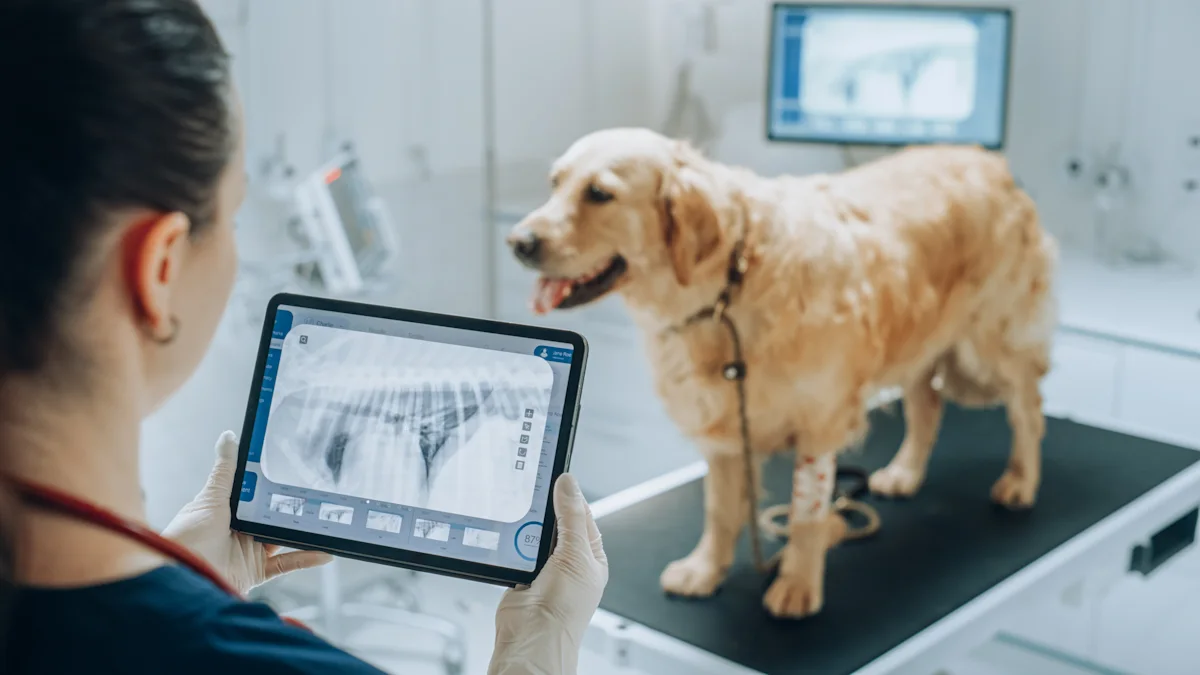
AI tools can flag subtle changes in radiographs that help veterinarians catch problems earlier.
(SeventyFour / Shutterstock)
Radiology happens to be Dr. Bailey’s own specialty, so I pressed him on whether AI can genuinely catch something a trained veterinarian might miss. “AI can perform a number of routine tasks faster than people can,” he explained. “This includes repetitive tasks such as placing the radiographs in order as well as the vital work of a second set of eyes for interpreting radiographs.”
What stood out most was his description of how subtle these changes can be. “AI can observe very subtle changes in diagnostic images over time before a human can, so progression of disease or other problems can be detected earlier, which can lead to improved outcomes,” Dr. Bailey said.
He added that “AI can see subtle changes that may be very hard for human eyes to observe and bring those changes to the attention of the veterinarian, who then will make a diagnosis and formulate a treatment plan.” Independent research backs this up. A study published on PMC found that an AI system detecting distal radius fractures achieved 95.90 percent accuracy, performing nearly identically to an experienced orthopedic surgeon reading the same images.
Dr. Bailey also described AI as a kind of early warning system for conditions that used to sneak up on pet owners. “Predictive analytics can act as diagnostic co-pilots integrating vast amounts of data to forecast diseases, like feline kidney disease before clinical signs appear, giving owners and veterinarians an opportunity to treat proactively and reduce chronic or long-term effects of disease,” he shared. He was careful to circle back to the same theme he returns to throughout our conversation: “AI is very valuable in gathering data, analyzing, transcribing, and performing repetitive tasks, but remember that it does not replace the veterinarian.”
Smart collars and wearables are giving vets a new stream of data

Smart collars and wearables can track a pet’s heart rate, activity, and behavior between vet visits.
(Wirestock Creators / Shutterstock)
Fitness trackers aren’t just for people anymore, and I wanted to know if the data from a pet’s smart collar actually holds up once you’re sitting in the exam room. “Well-designed and scientifically validated wearables have great potential to improve delivery of veterinary care, telling veterinarians what animals and their owners cannot, and facilitating individualized care,” Dr. Bailey explained. “However, if veterinarians are to rely on them for diagnostic purposes, the devices need to be evaluated for accuracy and reliability in the species of intended use.”
According to Dr. Bailey, these devices can track a surprising range of information. “Features vary by product and can include recording electrocardiograms; continuous, non-invasive monitoring of vital parameters; activity level (including sleeping habits); and certain behaviors like shaking, scratching, or food consumption,” he said.
AI is taking the paperwork off vets’ plates so they can focus on your pet

AI scribes and digital record systems are freeing up veterinarians to spend more time with patients.
(Hananeko_Studio / Shutterstock)
Anyone who has waited while a vet types notes into a laptop mid-appointment will appreciate this next part. Dr. Bailey described a philosophy the profession has embraced: “AI is helping take ‘the robot out of humans.’ By automating administrative and repetitive tasks, veterinary professionals can spend more time on what matters most: caring for animals and connecting with pet owners.”
He specifically called out voice technology as a game changer for busy clinics. “AI scribes and voice-to-text tools reduce the workload for veterinary professionals, improve record accuracy, and allow them to focus on personalized patient care and meaningful client communication,” Dr. Bailey shared.
Beyond scribing, he pointed to broader software systems now standard in most practices. “When used as intended, practice information management systems (PIMS) can standardize and enhance record-keeping, boost operational efficiency, bolster veterinary team engagement, and improve patient outcomes and client satisfaction, among other benefits,” he explained, noting these platforms often include “electronic medical records, appointment scheduling, client dashboards, and smartphone applications that allow clients to view pets’ medical records and test results.”
What AI still can’t do at the vet’s office

Hands-on exams, like palpation and listening to a heartbeat, are steps AI still can’t replace.
(Studio Romantic / Shutterstock)
I asked Dr. Bailey directly about the limits of this technology, and his answer leaned on an unexpected source. “I’m going to borrow a phrase that IBM shared with its team members in the late 1970s: ‘A computer can never be held accountable. Therefore, a computer must never make a management decision,'” he said. “While not an exact parallel, I think the spirit behind that advice holds true for any discussion of veterinary medicine and AI.”
He was unambiguous about who remains in charge of your pet’s care. “The veterinarian and the veterinary team under their supervision are in charge and make the care decisions and treatment plans in consultation with the client,” Dr. Bailey told me. “AI is a tool, a very valuable tool, but a tool, and it supports the veterinary team that you trust to provide the best possible care for your pet or other animal. You always want a veterinarian involved to interpret any results or findings from an AI source.”
Dr. Bailey also reminded us that there are entire categories of information no algorithm can gather. “Even smelling a patient can give vital information to the skilled health care provider that a virtual provider cannot access,” he said, a detail that sums up just how physical and hands-on veterinary medicine still is at its core.
Telehealth lets vets check in between visits, but it has limits
Telehealth has exploded across human medicine, and Dr. Bailey walked us through how it works for animals. “‘Telehealth’ is an overarching term encompassing all uses of technology to deliver health information, education, guidance, or care remotely,” he explained. “It includes teleadvice, teletriage, telemedicine, telemonitoring, teleconsulting, and telesupervision.”
Telemedicine specifically comes with a legal guardrail most pet owners have never heard of. “‘Telemedicine’ is the practice of veterinary medicine using telecommunication technology that allows a licensed veterinarian with an existing veterinarian-client-patient relationship to evaluate, diagnose, prescribe for and/or otherwise treat a patient virtually,” Dr. Bailey said. He noted that “before using telemedicine, a licensed veterinarian should establish a veterinarian-client-patient relationship by conducting an in-person physical examination of the patient or a visit to the premises where the patient is kept,” with an exception “made for providing telemedicine for a life-threatening emergency or severe animal suffering until a VCPR can be established.” The AVMA’s telehealth policy confirms that a veterinarian-client-patient relationship cannot be established solely through electronic means in most states.
Used the right way, Dr. Bailey said telehealth genuinely strengthens the relationship between pets, owners, and their care team. He gave concrete examples, describing how “a veterinarian can use photos and video to help evaluate healing of incision sites; video to monitor the patient’s gait and overall mobility; video to see the patient’s general demeanor and evidence of return to normalcy after treatment; and electronic transfer of herd records to keep an eye on health and production.” Still, he was candid about its ceiling. “Telehealth limits diagnostic accuracy by preventing hands-on examinations like palpation, auscultation (listening to heart/lungs), and joint manipulation,” Dr. Bailey pointed out.
Does it matter if your vet’s office uses AI?
For pet owners choosing a new veterinarian, I asked whether AI capability should factor into the decision. Dr. Bailey redirected me to something more fundamental. “The most important consideration in choosing a veterinary practice are the people who work there, the veterinarians, the veterinary technicians, technologists and specialists, and the practice managers and other administrative staff,” he explained. “When choosing your veterinarian, I recommend that you use the same care and criteria that you would in selecting a physician or dentist.”
That said, he didn’t dismiss technology as irrelevant to the choice. “The range of medical services provided, tools used, and resources available, and these can include AI, are very significant factors,” Dr. Bailey noted. As for any lingering worry about a computer weighing in on a diagnosis, Dr. Bailey encouraged owners to simply ask. “For clients with questions about the use of AI in diagnosis and treatment, please talk to your veterinarian; they are here to help and guide you through the process,” he said.
What pet owners can expect from AI in the next five years
Looking ahead, Dr. Bailey resisted making bold predictions but was clear about the trajectory. “While I cannot predict specific AI advances, in general I expect to see a continuing and rapid pace of change in the availability and utilization of AI in veterinary medicine, with the veterinarians and their teams in the driver’s seat of patient care,” he said.
He also flagged a real limitation the industry is actively working through. “AI systems are only as good as the data that they are trained on. Inconsistent labeling, biased datasets, or poor-quality inputs can lead to inaccurate outputs,” Dr. Bailey explained.
One challenge is unique to animal medicine and doesn’t have a clean parallel in human health care. “One challenge we face compared with human medicine is that while physicians treat people, veterinarians treat many different species,” Dr. Bailey said. “Canine conformation displays far more physical variation than human anatomy where we have more than 200 breeds. So, the engineers and scientists working on AI development will have to account for our need to examine and evaluate the vast range of species that we treat.”
The bottom line: is AI actually helping pets?

Veterinarians say AI’s biggest benefit may be giving them more time to connect with pets and their owners.
(SeventyFour / Shutterstock)
I ended my conversation by asking Dr. Bailey the question every pet owner really wants answered. Does any of this actually translate to better outcomes, or is it still mostly hype? His answer was direct. “As a board-certified radiologist, I believe that AI is definitely leading to better outcomes,” he said. “AI helps us focus on the most meaningful part of veterinary medicine: caring for animals and connecting with clients. AI is already delivering real-world benefits for pets, veterinarians and public health.”
He was equally clear that the benefits extend past the exam room and into the wellbeing of the people providing care. “From removing repetitive tasks to faster diagnoses to earlier disease detection, AI is helping us improve outcomes for animals while also reducing stress on veterinary teams,” Dr. Bailey shared. “These new technologies enable veterinary technicians and assistants to work more efficiently by reducing workloads through automated administrative record-keeping and streamlined training, thus supporting their professional growth.”
He closed with the same caution that ran through the entire conversation, and it’s worth remembering the next time your pet’s chart mentions an AI-assisted scan. “Responsible use of AI requires trust, transparency, good communication with clients, and strong veterinary leadership,” Dr. Bailey said. “Perhaps the most powerful way advanced technologies empower veterinarians is to give us more time to care for our patients and support our clients. We must always keep a human in the loop to maintain the best pet health care.”
Thank you for reading. For more stories about pets and their well-being, I invite you to follow me on Yahoo.
More About Our Expert:

Dr. Michael Q. Bailey, DVM, DACVR, president of the American Veterinary Medical Association
(Tom Wenger)
Dr. Michael Q. Bailey, the 2025-2026 president of the American Veterinary Medical Association, was born in Queens, New York, and raised in Hopewell, New Jersey. He earned his undergraduate degree from Rutgers University’s College of Agriculture and Environmental Sciences before completing his DVM at Tuskegee University and an internship and radiology residency at Michigan State University. A board-certified radiologist, he has served on the faculty at Tuskegee and Michigan State and achieved tenure at The Ohio State University, and he has contributed to both veterinary and human medical literature. Through an AAAS/AVMA congressional fellowship, he worked as a full-time scientific legislative advisor in a congressional office, applying his veterinary expertise to shaping legislation. Dr. Bailey pioneered Ohio’s first private-practice advanced veterinary CT imaging services, launched referral and emergency imaging facilities in Pittsburgh, and served as lead radiologist for a nationwide veterinary practice spanning more than 1,000 facilities. He currently serves as director of medical innovations in telemedicine for a global telemedicine consulting business. His volunteer leadership includes serving as president of the Pennsylvania Veterinary Medical Association and a six-year term on the AVMA Board of Directors representing District 2. Outside of work, he enjoys traveling with his wife, rebuilding classic cars and motorcycles, and photography.
Please note: This article is intended for general educational purposes and reflects the views and expertise of Dr. Michael Q. Bailey as shared directly in this interview. It isn’t meant to replace individualized veterinary advice, diagnosis, or treatment. Every pet is different, and any questions about your own pet’s health, medical records, or the technology used in their care should be directed to your veterinarian.