Blog
Planes, trains, hotels catering more to travelers and their pets

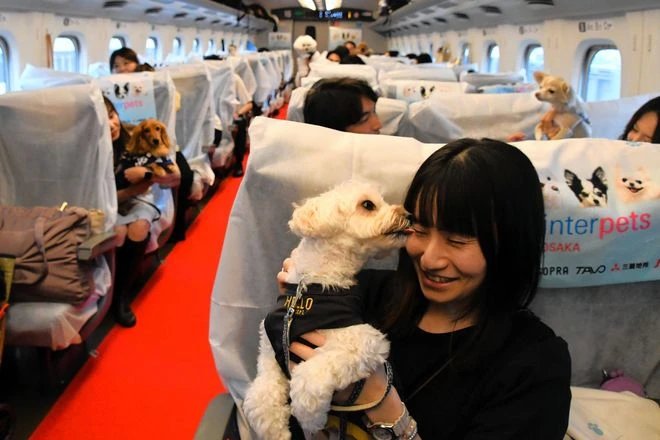
Passengers are given an opportunity to travel with their pet dogs on a Shinkansen train. (Compiled from footage filmed by Akihito Ogawa and Takashi Yoshida)
Usually packed with quiet business passengers, a Tokaido Shinkansen hosted lively travelers of the four-legged variety instead as it departed from JR Tokyo Station on a recent summer day.
Slightly past 10 a.m. on June 20, the bullet train was filled with dogs of small breeds and their owners in the seats.
A woman in her 40s, an artist from Tokyo’s Shinjuku Ward, was in the crowd with Haru, her pet Chihuahua.
“This opportunity allows me to look at the scenery out the window alongside Haru,” the pet owner said, her smiling eyes falling on her dog. “This little one seems relaxed and in a good mood.”
Lively barks of other dogs were heard reverberating in the surroundings.
The tour program was fittingly called “Wan-Wan Express” (Bow-wow express).
Expanding service options are becoming available for those who travel with their pets in Japan, where the human population is shrinking.
NOT JUST ‘BAGGAGE’ ANYMORE
Shinkansen cars and luxury accommodations reserved exclusively for travelers with dogs are among the hot items of the “pawprint economy,” which refers to spending associated with travels and other similar activities specifically with canines.
Dogs that accompany human passengers on a Shinkansen usually have to be kept in a tightly shut cage as a piece of “baggage.”
On this specific occasion, however, the passengers were allowed to take their dogs out of their cages in the train car fully booked for the program.
They were also allowed, while the train was running, to take commemorative photos of their pet dogs in a specially designed railroad worker’s cap, and even walk their canines.
Officials of Central Japan Railway Co. (JR Tokai), which operates the Tokaido Shinkansen Line, said the fares started at 47,800 yen ($296), including tax, for an owner and a pet dog.
The service was operated on a trial basis to coincide with Interpets Osaka, an international trade fair of the pet industry, which was held in the western megalopolis on June 20 and 21.
A 51-year-old man, a corporate employee who lives in Kawasaki, Kanagawa Prefecture, rode the train with Poko, his toy poodle.
“I go on domestic trips often, but I usually refrain from bringing Poko on a Shinkansen out of concern for my fellow passengers,” he said. “I hope services of this kind will no longer be anything special.”
The JR Tokai officials said that, when the program was over, they would carefully clean the train car and study if there were any residual pet odors and allergens to help them prepare for subsequent programs.
“A growing number of people are wanting to travel with their pet dogs as customer demand is diversifying,” said Makoto Akiyama, head of the Corporate Sales Section in JR Tokai’s Marketing Division who was in charge of the program. “We hope to continue meeting their expectations, while at the same also exercising consideration for the other customers.”
RESORT HOTELS OPEN TO FIDO
Tetsutaka Suda, CEO of pet salon chain operator Sopra Ginza, helped operate the Wan-Wan Express program.
He said he believes there is large demand for traveling with pets.
“Pets are becoming closer members of a family, as more and more households are keeping them indoors, instead of outdoors,” Suda said.
Yano Research Institute Ltd. valued the pet-related market at 1.9108 trillion yen in fiscal 2024, up 2.6 percent year on year, which will continue to grow.
Spending related to travel and other similar activities with dogs is drawing attention overseas under the pawprint economy moniker, and the associated market is expanding.
A recent survey by Petgo Corp., which operates online retailing of pet-related goods and other similar services, found that about 30 percent of dog owners had made overnight domestic trips with their pet dogs during the past year.
Most cited private cars as their means of transportation for their overnight domestic trips with dogs. Only 6.7 percent cited Shinkansen and 6.2 percent cited other trains as the transport mode.
The survey was taken of Petgo subscribers, of which 1,942 responded.
The dog owners were also asked what social infrastructure facilities should there be more of in society.
The response that led the list included accommodations that humans can use with their pets, cited by 62.0 percent of the respondents; restaurants where humans can dine with their pets, at 60.4 percent; and means of transportation that humans can take with their pets, at 53.1 percent.
Some businesses are putting much effort on accompanied pet services, as they expect the corresponding market to grow.
Tokyo Tatemono Co., a major real estate developer, opened Regina Resorts, a chain of luxury resort hotels for lodgers with pet dogs, in 2013. The chain now comprises 10 facilities across Japan.
A club operated by Regina Resorts had 102,000 household members as of June this year. The membership count has been growing at 10 percent per annum in the latest years.
More than 60 percent of Regina Resort lodgers are repeat customers, officials said.
Tokyo Tatemono opened a premium zone with a private dog run at Regina Resort Yufuin in Oita Prefecture on July 3.
Slip-resistant and stain-resistant flooring is used in the zone to prevent accidents involving the guests’ pet dogs, who would also be served meals.
Rates start at 79,200 yen per person for an overnight stay with two meals. Wall sockets are installed at relatively high positions to prevent accidental electric shocks.
A certified pet care manager and other experts have also been hired to deal with trouble that may arise between pet dogs, the officials said.
UP IN THE AIR
Airline company Star Flyer Inc. has been offering a carry-on pet service called “Fly with (your) Pet!” on all flights since January 2024.
It allows passengers to bring a small dog or cat in a cage into the cabin and place it on a seat.
The air carrier first started offering the service on one of its routes in March 2022 to develop a new client base following a drop in business demand during the COVID-19 pandemic.
Previously, pets had to be checked in and kept in the cargo bay even with airline companies that allowed pets aboard.
Star Flyer officials said the carry-on pet service, priced at 50,000 yen per pet, has been used several hundred times a year, and the demand has been greater along routes of longer distances.
The service requires a pet to be kept in a cage, which should be fixed to a seat wrapped in a cover and padded with a cushion.
Measures are being taken to minimize the scattering of pet hair to prevent allergies in passengers seated nearby.
Pet owners who utilize the service are requested to brush their pets by the day before their flight. Once in the cabin, the pets have to be kept in a cage made of mesh material with small apertures.
The seats are cleaned intensively after the pets have left the plane, the officials added.
(This article was written by Akihito Ogawa and Takashi Yoshida.)