Blog
Comprehensive Study on Companion Animal Health Market Now

Dublin, July 14, 2026 (GLOBE NEWSWIRE) — The “Companion Animal Health Market by Animal Type, Product Type, Formulation, Distribution Channel, Therapeutic Area – Global Forecast 2026-2032” has been added to ResearchAndMarkets.com’s offering.
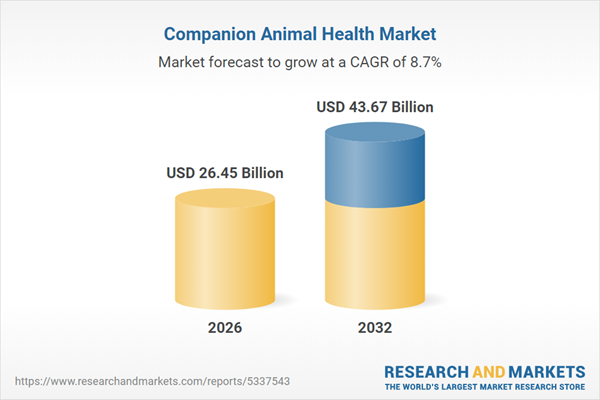
The Companion Animal Health Market is projected to reach USD 26.45 billion in 2026, continuing to grow at a CAGR of 8.66%, reaching USD 43.67 billion by 2032.
The companion animal health market is expanding as pet owners increasingly treat dogs, cats, and other companion animals as family members. Demand is concentrated across veterinary pharmaceuticals, vaccines, parasiticides, diagnostics, nutrition, pain management, dermatology, dental care, surgical products, and digital veterinary services.
Verified industry indicators support the sector’s resilience. The American Pet Products Association reported U.S. pet industry expenditures of about USD 147 billion in 2023, with veterinary care and product spending remaining a major category. In Europe, FEDIAF data continue to show pet ownership across millions of households, reinforcing demand for preventive care, chronic disease management, and evidence-based companion animal health solutions.
Transformative Shifts in the Companion Animal Health Landscape
The companion animal health landscape is shifting from episodic treatment toward preventive, continuous, and data-enabled veterinary care. Pet owners are seeking earlier diagnostics, wellness plans, parasite prevention, nutrition guidance, and therapies that improve quality of life for aging animals. Veterinary clinics are adopting point-of-care diagnostics, practice-management platforms, and integrated pharmacy services to improve clinical efficiency.
Innovation is accelerating in monoclonal antibodies, long-acting parasiticides, dermatology, osteoarthritis pain management, vaccines, and specialty diagnostics. At the same time, veterinary workforce shortages, cost sensitivity, and regulatory scrutiny from agencies such as the U.S. FDA Center for Veterinary Medicine and the European Medicines Agency are reshaping product development, access, and commercialization strategies.
Cumulative Impact of Artificial Intelligence
Artificial intelligence is becoming a practical capability across companion animal health rather than a standalone trend. AI-enabled imaging review, laboratory result interpretation, clinical decision support, and tele-triage can help veterinarians prioritize cases, reduce administrative burden, and improve consistency in routine workflows.
The strongest near-term value lies in augmenting veterinary professionals, not replacing them. AI tools can support wearable-based monitoring, early disease detection, inventory forecasting, pharmacovigilance, and personalized care reminders. However, adoption depends on validated algorithms, transparent data governance, cybersecurity, clinician oversight, and compliance with veterinary medical standards.
Key Regional Insights
Asia-Pacific is gaining momentum as urbanization, rising disposable income, and pet humanization increase demand for vaccines, diagnostics, nutrition, and clinic services. North America remains one of the most mature regions, supported by high pet ownership, advanced veterinary infrastructure, and strong pet insurance adoption.
Latin America is advancing through expanding private veterinary networks, while Europe benefits from established animal welfare standards, regulation, and strong preventive care adoption. The Middle East, especially high-income Gulf markets, is seeing premiumization in companion animal services, including specialty clinics and imported therapeutics. Africa remains more access-driven, with opportunities tied to vaccination, parasite control, and broader veterinary service availability.
Key Group Insights
ASEAN markets show rising demand for companion animal vaccines, nutrition, diagnostics, and retail veterinary services, but regulatory fragmentation requires localized planning. The GCC is characterized by import-driven premium veterinary products, growing specialty clinics, and advanced care willingness in urban centers.
The European Union offers harmonized regulatory pathways, high animal welfare expectations, and strong demand for proven safety and efficacy. BRICS countries provide scale through large pet populations, yet pricing and veterinary infrastructure vary widely. G7 markets anchor innovation, clinical standards, and digital adoption, while NATO countries add relevance through biosecurity and coordinated animal health preparedness.
Key Country Insights
The United States leads in companion animal spending and innovation commercialization, while Canada emphasizes preventive care and regulated product quality. Mexico and Brazil are important Latin American markets with growing urban pet ownership.
In Europe, the UK, Germany, France, Italy, and Spain combine high pet ownership with advanced veterinary services and preventive medicine adoption. In Asia-Pacific, China and India offer scale through expanding pet populations, and Japan and South Korea show strong premiumization and advanced clinic standards.
Actionable Recommendations for Industry Leaders
Industry leaders should prioritize portfolios aligning with clinical needs: preventive care, dermatology, pain management, parasiticides, vaccines, diagnostics, dental health, nutrition, and chronic disease monitoring. Companies should validate AI and digital health tools in veterinary settings, build compliant data systems, and localize strategies by region.
Partnerships with clinics, diagnostic laboratories, insurers, e-commerce platforms, shelters, and academic institutions can improve access while strengthening trust in companion animal health brands.
Research Methodology
This summary is based on triangulated secondary research from veterinary regulatory agencies, animal health associations, peer-reviewed literature, trade data, and recognized pet ownership sources, including APPA, FEDIAF, FDA CVM, EMA, WOAH, and national veterinary bodies.
Insights were developed by comparing demand indicators such as pet ownership, veterinary expenditure, clinic infrastructure, product approvals, disease-prevention priorities, and digital adoption. Assessments emphasize verified structural drivers over unsubstantiated forecasts.
Conclusion
Companion animal health is positioned for durable expansion as pet humanization, preventive medicine, veterinary innovation, and digital care converge. The market spans beyond pharmaceuticals to inclusive diagnostics, nutrition, monitoring, telehealth support, and insurance-enabled care.
Organizations combining scientific credibility, regulatory discipline, and veterinarian-centered commercialization will be well-positioned for long-term value, improving access, outcomes, affordability, and trust across global pet care markets.
Key Attributes:
| Report Attribute | Details |
| No. of Pages | 186 |
| Forecast Period | 2026 – 2032 |
| Estimated Market Value (USD) in 2026 | $26.45 Billion |
| Forecasted Market Value (USD) by 2032 | $43.67 Billion |
| Compound Annual Growth Rate | 8.6% |
| Regions Covered | Global |
Key Topics Covered:
1. Preface
1.1. Objectives of the Study
1.2. Market Definition
1.3. Market Segmentation & Coverage
1.4. Years Considered for the Study
1.5. Currency Considered for the Study
1.6. Language Considered for the Study
1.7. Key Stakeholders
2. Research Methodology
2.1. Introduction
2.2. Research Design
2.2.1. Primary Research
2.2.2. Secondary Research
2.3. Research Framework
2.3.1. Qualitative Analysis
2.3.2. Quantitative Analysis
2.4. Market Size Estimation
2.4.1. Top-Down Approach
2.4.2. Bottom-Up Approach
2.5. Data Triangulation
2.6. Research Outcomes
2.7. Research Assumptions
2.8. Research Limitations
3. Executive Summary
3.1. Introduction
3.2. CXO Perspective
3.3. Market Size & Growth Trends
3.4. Market Share Analysis, 2025
3.5. FPNV Positioning Matrix, 2025
3.6. New Revenue Opportunities
3.7. Next-Generation Business Models
3.8. Industry Roadmap
4. Market Overview
4.1. Introduction
4.2. Industry Ecosystem & Value Chain Analysis
4.2.1. Supply-Side Analysis
4.2.2. Demand-Side Analysis
4.2.3. Stakeholder Analysis
4.3. Market Dynamics
4.3.1. Key Drivers
4.3.2. Key Restraints
4.3.3. Key Opportunities
4.3.4. Key Challenges
4.4. Porter’s Five Forces Analysis
4.5. PESTLE Analysis
4.6. Market Outlook
4.6.1. Near-Term Market Outlook (0-2 Years)
4.6.2. Medium-Term Market Outlook (3-5 Years)
4.6.3. Long-Term Market Outlook (5-10 Years)
4.7. Go-to-Market Strategy
5. Market Insights
5.1. Consumer Insights & End-User Perspective
5.2. Consumer Experience Benchmarking
5.3. Opportunity Mapping
5.4. Distribution Channel Analysis
5.5. Pricing Trend Analysis
5.6. Regulatory Compliance & Standards Framework
5.7. ESG & Sustainability Analysis
5.8. Disruption & Risk Scenarios
5.9. Return on Investment & Cost-Benefit Analysis
6. Cumulative Impact of Artificial Intelligence 2026
7. Companion Animal Health Market, by Animal Type
7.1. Cat
7.2. Dog
7.3. Horse
8. Companion Animal Health Market, by Product Type
8.1. Diagnostics
8.1.1. Imaging
8.1.2. In Vitro Diagnostics
8.1.3. Monitoring Devices
8.2. Nutrition
8.2.1. Specialized Pet Food
8.2.2. Supplements
8.3. Pharmaceuticals
8.3.1. Anti-Inflammatories
8.3.2. Antibiotics
8.3.3. Endocrine Treatments
8.3.4. Pain Management
8.3.5. Parasiticides
8.4. Vaccines
9. Companion Animal Health Market, by Formulation
9.1. Injectable
9.2. Oral
9.3. Topical
10. Companion Animal Health Market, by Distribution Channel
10.1. Online Retail
10.2. Pet Specialty Stores
10.3. Pharmacies
10.4. Veterinary Clinics
11. Companion Animal Health Market, by Therapeutic Area
11.1. Cardiovascular
11.2. Dental
11.3. Dermatology
11.4. Endocrine
11.5. Orthopedic
11.6. Parasitology
12. Asia-Pacific Companion Animal Health Market
13. Europe Companion Animal Health Market
14. North America Companion Animal Health Market
15. Latin America Companion Animal Health Market
16. Africa Companion Animal Health Market
17. Middle East Companion Animal Health Market
18. NATO Companion Animal Health Market
19. G7 Companion Animal Health Market
20. European Union Companion Animal Health Market
21. BRICS Companion Animal Health Market
22. ASEAN Companion Animal Health Market
23. GCC Companion Animal Health Market
24. United States Companion Animal Health Market
25. China Companion Animal Health Market
26. Germany Companion Animal Health Market
27. Japan Companion Animal Health Market
28. India Companion Animal Health Market
29. United Kingdom Companion Animal Health Market
30. France Companion Animal Health Market
31. Canada Companion Animal Health Market
32. Italy Companion Animal Health Market
33. Australia Companion Animal Health Market
34. South Korea Companion Animal Health Market
35. Brazil Companion Animal Health Market
36. Mexico Companion Animal Health Market
37. Russia Companion Animal Health Market
38. Spain Companion Animal Health Market
39. Competitive Landscape
39.1. Market Concentration Analysis, 2025
39.1.1. Concentration Ratio (CR)
39.1.2. Herfindahl Hirschman Index (HHI)
39.2. Recent Developments & Impact Analysis, 2025
39.3. Product Portfolio Analysis, 2025
39.4. Benchmarking Analysis, 2025
Companies Featured
The companies featured in this Companion Animal Health market report include:
- Agrolabo S.p.A.
- Bio-Rad Laboratories, Inc.
- Biogal Galed Labs
- BioMérieux S.A.
- BioNote, Inc.
- Demeditec Diagnostics GmbH
- Eurofins Technologies
- Fassisi GmbH
- FUJIFILM Holdings Corporation
- IDEXX Laboratories, Inc.
- IDvet
- Mars, Incorporated
- Neogen Corporation
- Nisseiken Co., Ltd
- Phibro Animal Health Corporation
- Qiagen N.V.
- Randox Laboratories, Ltd.
- Shenzhen Bioeasy Biotechnology Co., Ltd.
- Shenzhen Mindray Animal Medical Technology Co., Ltd.
- SKYER, Inc.
- Skyla Corporation
- Thermo Fisher Scientific Inc.
- Vimian Group AB
- Virbac S.A.
- Zoetis Inc.
For more information about this report visit
About ResearchAndMarkets.com
ResearchAndMarkets.com is the world’s leading source for international market research reports and market data. We provide you with the latest data on international and regional markets, key industries, the top companies, new products and the latest trends.
- Companion Animal Health Market