Blog
New Beauty Launches 2026: Skincare, Haircare and Makeup Products to Know

The Indian luxury home is quietly changing. An expensive home is no longer defined by oversized furniture, imported labels, and visible symbols of wealth. Instead, a gradual shift toward a more personal idea of luxury. Today’s consumers want homes that are sophisticated yet lived-in, distinctive yet functional, and based on craftsmanship rather than price alone.
For affluent Indian consumers, luxury is increasingly about intention. A carefully made piece of furniture, handcrafted tableware, natural materials, personalised interiors or a sofa designed around a particular space can carry more value than a room filled with recognisable luxury labels.
According to Deloitte India’s Powering Consumption Growth: India’s Home and Household Market report, India’s home and household sector is projected to reach around USD 237 billion by 2030, growing at a CAGR of more than 10 percent. The report identifies rising disposable incomes, changing preferences, digital platforms, home renovation and personalisation as key growth drivers.
Meanwhile, Grand View Research estimates India’s home décor market at USD 17.2 billion in 2024, projected to reach USD 27.6 billion by 2030, growing at an 8.4 percent CAGR. The luxury furniture market is estimated at USD 1.12 billion in 2025 and is expected to reach USD 1.74 billion by 2031, according to Mordor Intelligence.
Also read: How Footwear Brands Are Expanding Across Tier II & Tier III India
From Opulence to Intention
The biggest change in the luxury home segment is the definition of luxury itself.
“Luxury is moving from excess to intention. Consumers increasingly value thoughtful design, craftsmanship, functionality and authenticity – products that add meaning to everyday living rather than simply signalling status,” said Ayush Baid, Founder, ellementry.
Hridik Chawla, Co-founder, Essentia Home, described the change as “the shift from display to depth.”
“For a long time, a luxury home was outward-looking. The question people asked was how it would impress others. That has changed,” he said. “Today the client looks inward. It has become far more about how a home makes you feel, about the quality of an ordinary morning in a space that was made carefully for you.”
According to Chawla, today’s affluent consumer is globally exposed but increasingly confident about personal preferences.
“They have travelled. They know what good looks like internationally, and what they are asking for is something that reflects who they are rather than signalling what they can afford,” he added.
Also read: Korum Mall Adapts to Changing Shopper Behaviour with Stronger Spending, Experiences
Craftsmanship Takes Centre Stage
As consumers become more discerning, craftsmanship is emerging as one of the strongest markers of premium value.
“Consumers are becoming more conscious of what they bring home, showing greater appreciation for handcrafted products, natural materials and thoughtful design that combine aesthetics with purpose,” stated Baid.
For Essentia Home, this demand has translated into a strong focus on Indian manufacturing and locally sourced materials. The brand has more than 1,000 proprietary designs, made in India, with an emphasis on Indian stone.
“The expectation around craft has matured considerably. It is no longer nostalgia. Clients today want craft that meets precision, tradition that holds up against global standards of finish and detailing,” said Chawla.
Sustainability is also becoming part of the conversation, although consumers are increasingly looking beyond broad claims.
“The biggest impact comes from using less. Fewer, better elements rather than more,” Chawla highlighted. “We use materials judiciously, reduce wastage and repurpose what remains.”
Also read: Smoke Lab Vodka: A Premium Indian Vodka Brand in a Changing Market
Accessible Luxury Gains Ground
Premiumisation does not always mean purchasing the most expensive product. Consumers are increasingly looking for better materials, craftsmanship and durability at prices they perceive as justified.
Raghunandan Saraf, Founder and CEO, Saraf Furniture, said consumers are shifting towards “mindful, long-lasting pieces instead of chasing short-term trends.”
“Consumers are shifting toward solid wood plus that heritage craftsmanship, but still with contemporary functionality that feels current, not just antique,” he mentioned.
Saraf describes this as “an accessible kind of luxury way.” With a D2C-led model, Saraf Furniture offers handcrafted Sheesham wood furniture across a price range of approximately Rs 999 to Rs 2.5 lakh, with beds among its best-selling products.
The trend reflects a broader shift towards value-driven premiumisation, where consumers are willing to spend more when the improvement in quality, material, and longevity is tangible.
Also Read: Rupa Expands Retail Reach as Apparel Demand Shifts Beyond Innerwear
 Digital Reach, Genuine Experience
The luxury home category is also finding a balance between digital convenience and physical experience.
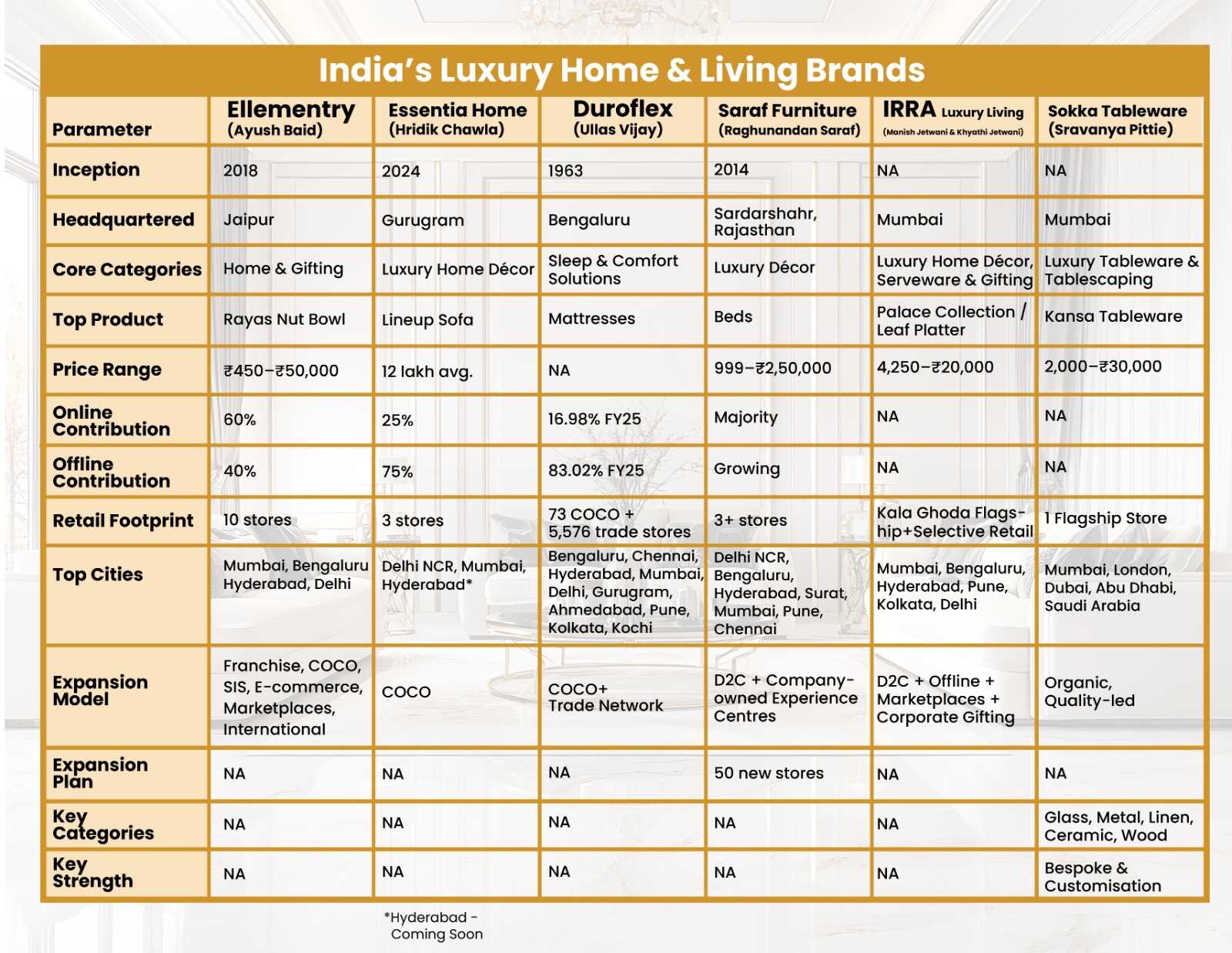
Ellementry currently derives 60 percent of its contribution online and 40 percent offline, with 10 retail stores. Its key markets include Mumbai, Delhi, Hyderabad and Bengaluru. Founded in 2018 and headquartered in Jaipur, the brand operates through franchise, COCO and SIS formats alongside e-commerce, marketplaces and international channels.
“We plan to accelerate digital and international expansion, strengthen marketplaces and quick commerce, optimise our stores, and deepen our omnichannel presence across high-potential domestic and global markets,” said Baid.
For furniture and luxury décor, however, physical interaction remains important.
Essentia Home has expanded from its flagship in Gurugram to Delhi and Mumbai, with Hyderabad planned next, followed by Bengaluru, Chennai, Kolkata and Coimbatore.
“The idea in each city is the same: give people a space where they can touch, feel and experience the products rather than only see them on a screen or in a catalogue,” said Chawla. “That physical experience is irreplaceable in this category.”
Saraf Furniture follows a similar hybrid model, combining D2C online retail with experience centres in Delhi, Bengaluru, Hyderabad and Surat, while planning to open 50 new stores.
“The online side helps us scale while the offline presence builds trust,” added Saraf.
Personalisation Becomes a Luxury
Customisation is increasingly becoming a defining feature of premium home improvement.
At Essentia Home, customisation is closely linked to its in-house manufacturing ecosystem.
“Bringing manufacturing in-house lets us align design intent with execution directly, experiment freely and customise at scale while holding consistency across every element in a space,” said Chawla.
“In luxury, the difference often lies in the millimetre,” he added.
For the company, made-to-order is not an additional premium service but the default, with furniture, layouts, materials and finishes developed around individual client requirements.
Sokka Tableware is also seeing strong demand for bespoke products.
Sravanya Pittie, Founder, Sokka Tableware, said, “Customisation is extremely important to us because it allows us to respond to how individual clients want to live and entertain.”
“One of Sokka Tableware’s strengths is that we can execute bespoke requirements quickly and across multiple materials,” she said.
The brand can carry similar colours, detailing and proportions across linen, crockery and cutlery, creating a cohesive table setting.
“For us, bespoke is about creating something that feels genuinely considered for the individual and their space,” Pittie added.
Indian Craft Meets Contemporary Design
Another important shift is the reinterpretation of Indian craftsmanship.
Consumers are increasingly interested in Indian materials and traditions, but they want them expressed through contemporary forms.
“For us, modern Indian luxury is where craftsmanship meets contemporary design, bringing India’s materials, traditions and sensibilities into everyday products that are functional, refined and relevant to modern homes,” said Baid.
Chawla put the evolution more directly: “Luxury does not need to be imported; it needs to be interpreted.”
He said the Indian luxury market has moved away from a dependence on imported marble, European fittings and global brand names.
“Our work sits at an intersection: Indian in its warmth, craft and texture, and global in its restraint, spatial clarity and flow,” he said.
For Manish Jetwani and Khyathi Jetwani, Founders, IRRA Luxury Living, this is “heritage without nostalgia.”
“The new luxury home is less about displaying wealth and more about curating meaning,” they said.
IRRA creates contemporary silver-plated home décor, serveware, gifting and devotional objects, handcrafted in premium brass or copper and finished with sterling silver plating. Its products range from approximately Rs 4,250 to Rs 20,000.
Quiet Luxury Becomes Mainstream
The growing preference for understated design is particularly visible in tableware and home accessories.
“There is a shift from what I would call screaming luxury towards something much more subtle and chic,” said Pittie.
For her, modern Indian luxury is about “quiet confidence”: products that are elegant, distinctive and beautifully made without relying on obvious branding.
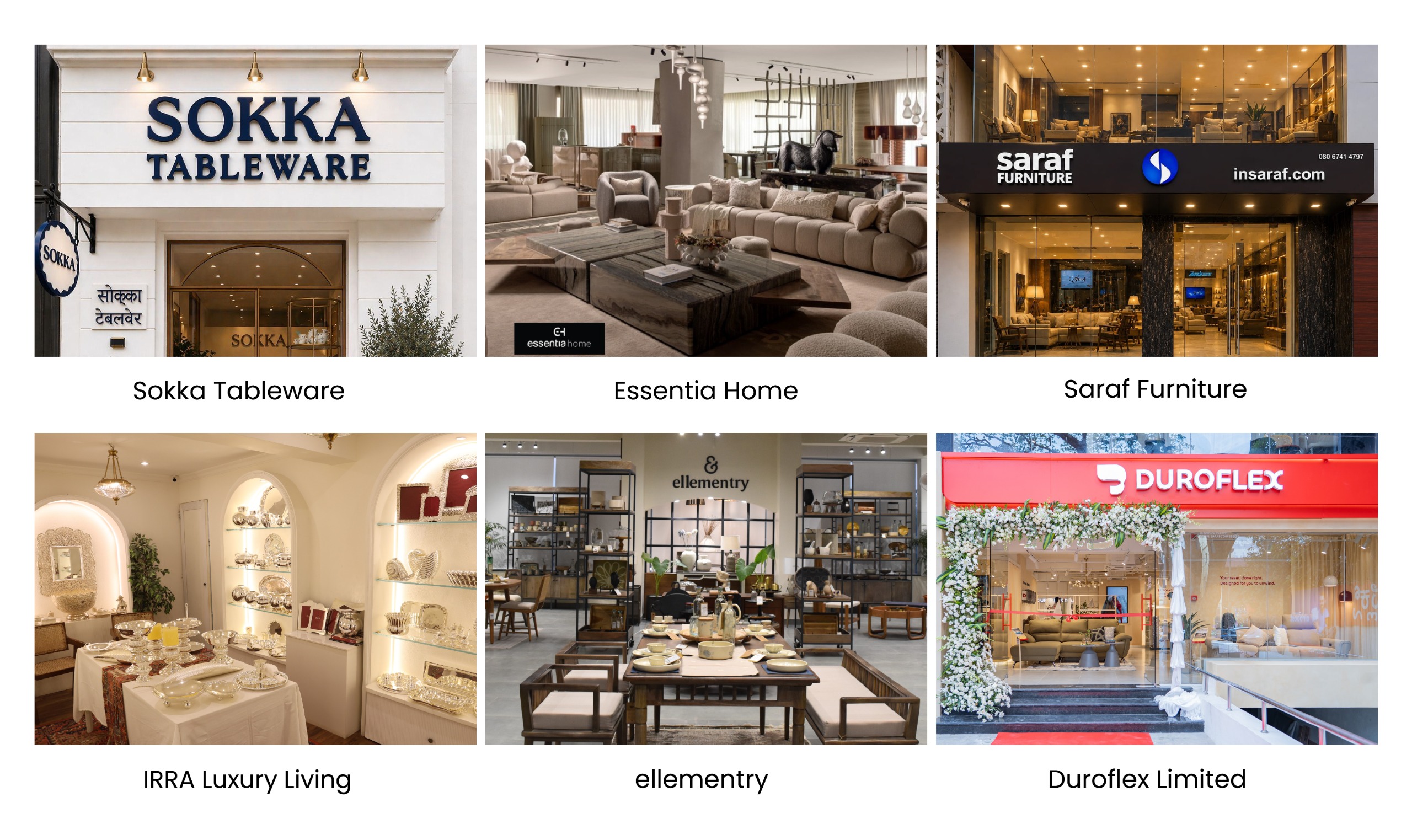
Sokka Tableware’s portfolio spans glass, metal, linen, ceramic and wood, with Kansa tableware among its customer favourites. Its products range from Rs 2,000 to Rs 30,000. The brand has a flagship store in Mumbai and international markets including London, Dubai, Abu Dhabi and Saudi Arabia.
Pittie said the ambition is to take an inherently Indian point of view to a global audience without losing its design identity.
Functionality Joins the Luxury Equation
Luxury is also becoming more functional.
Ullas Vijay, CMO, Duroflex Limited, said consumers are increasingly choosing “design-led, multifunctional products that combine comfort, aesthetics and technology.”
Duroflex’s offering spans mattresses, foam, sofas, recliners, beds, pillows, accessories and other furnishings. Mattresses contributed 51.41 percent of FY2025 revenue, or Rs 583.07 crore.
The company’s business remains predominantly offline, with 83.02 percent of FY2025 revenue coming from offline channels and 16.98 percent from online channels. As of June 30, 2025, it had 73 COCO stores across 31 cities, 14 states and two Union Territories, alongside 5,576 trade stores and 375 distributors.
Its product innovation includes motion sofas with Zero Wall Recline, Zero Gravity and USB ports, while AirBoost focuses on adaptive support and breathability.
“For Duroflex, modern Indian luxury means intelligent comfort, which involves premium materials, thoughtful design, personalisation, and technology creating elevated sleep experiences,” stated Vijay.
Expansion Beyond the Metros
The next phase of luxury home improvement is likely to extend beyond India’s established luxury centres.
Brands are increasingly looking at cities such as Hyderabad, Bengaluru, Chennai, Kolkata and Coimbatore, alongside Mumbai, Delhi and Gurugram.
Essentia Home is expanding into several of these markets, Saraf Furniture is targeting 50 new stores, and Ellementry is strengthening both domestic and international channels.
Sokka Tableware is also building its international presence, while IRRA is expanding through D2C, selective offline retail, premium marketplaces and corporate and luxury gifting.
The expansion reflects a wider change in Indian consumption: premium home products are no longer restricted to a small group of metros or traditional luxury consumers.
A More Personal Definition of Luxury
The Indian luxury home is becoming more personal, purposeful and experience-led. Consumers are looking for craftsmanship, quality, functionality and design that reflects their individuality rather than simply signalling status.
“Luxury is moving from excess to intention,” said Baid.
“The new luxury home is less about displaying wealth and more about curating meaning,” said IRRA founders.
For Chawla, luxury is about creating spaces that feel “calm, grounded and enduring,” while Pittie describes the new luxury as “quiet confidence.”
Saraf saw the opportunity in “value-for-money luxury,” combining craftsmanship with durability and contemporary functionality. For Vijay, it is about “intelligent comfort” through design, technology and personalisation.
Together, these perspectives reflect a clear shift in the market: luxury is no longer about having more, but about choosing better, living better and choosing with meaning.