
Blog
Ocean Road Magazine

WORDS: Ocean Road Editorial Staff PHOTOGRAPHY Skincare ingredients without the trends. Credit: Viorel Kurnosov/iStock
Skincare trends move quickly. One month, social media is filled with elaborate multi-step routines; the next, everyone is stripping their bathroom cabinet back to three products. New ingredients are constantly being labelled as the next breakthrough, while products can seemingly become overnight essentials after appearing in a viral video.
But healthy skin is rarely built around what happens to be trending.
While beauty trends can introduce consumers to useful ingredients and new approaches to skincare, the effectiveness of a product ultimately comes down to what is in the formula, how it has been formulated and whether those ingredients are appropriate for your skin.
Understanding a handful of well-established skincare ingredients can therefore be far more useful than trying to keep pace with every new trend.
Start With the Skin Concern, Not the Trend
One of the easiest ways to make skincare unnecessarily complicated is to choose products because they are popular rather than because they address a specific need.
Someone concerned about pigmentation, for example, may benefit from a very different combination of ingredients than someone primarily dealing with dryness or visible signs of ageing. Similarly, a product that works well for one person may cause irritation or simply offer little benefit to another.
A more considered approach starts by identifying what you actually want your skincare to achieve. From there, you can look for ingredients with established uses for that particular concern.
This shift from product-led to ingredient-led skincare also makes it easier to build a simpler routine where each product has a clear purpose.
Retinoids Remain a Benchmark for Skin Ageing
Few skincare ingredients have accumulated as much research as retinoids, a group of vitamin A derivatives that includes retinol.
Retinoids can increase skin cell turnover and influence collagen production, which is why they are commonly used to address concerns such as fine lines, uneven texture and pigmentation. However, they can also cause dryness and irritation, particularly when introduced too quickly.
Rather than choosing a retinol product based purely on the highest advertised concentration, formulation, frequency of use and the other products in your routine all matter.
Vitamin C Does More Than Brighten
Vitamin C has become a familiar skincare ingredient, but its popularity is supported by useful properties rather than beauty hype alone.
As an antioxidant, vitamin C can help protect the skin against oxidative stress caused by environmental factors. Certain forms of vitamin C may also support collagen production and help improve the appearance of uneven pigmentation.
However, simply seeing “vitamin C” on a label doesn’t tell the whole story. Different forms and concentrations are used in skincare, and stability and formulation can influence how effectively the ingredient is delivered.
Niacinamide Is a Versatile Supporting Ingredient
Niacinamide, a form of vitamin B3, is another ingredient that has moved into the mainstream for good reason.
It can support the skin barrier, help reduce water loss and improve the appearance of uneven tone. It is also generally well tolerated, making it a useful inclusion in routines where stronger active ingredients might otherwise increase dryness or sensitivity.
Its versatility is a good example of why ingredients don’t necessarily need to be new or dramatic to be valuable.
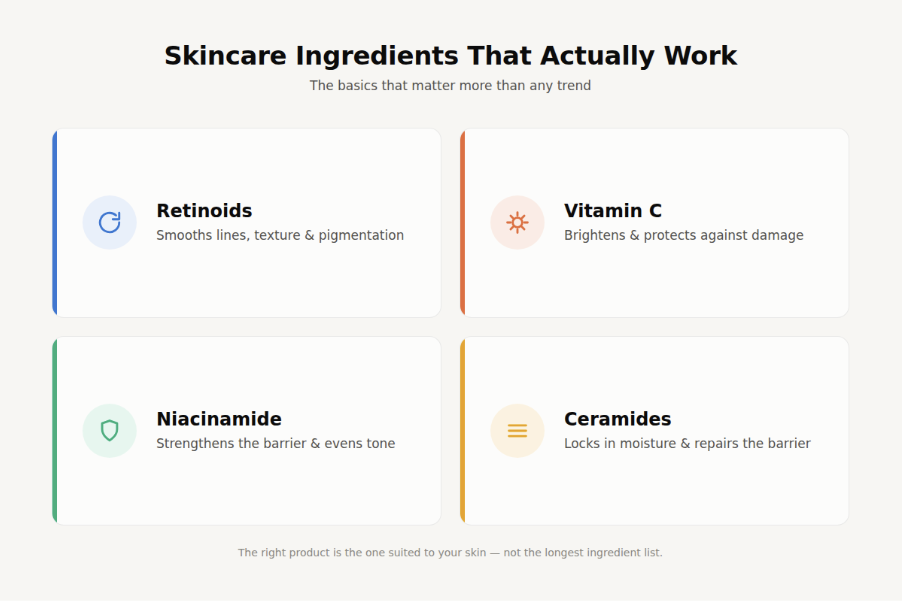
Image: Important skincare ingredients. Credit: Original/Custom
Don’t Overlook the Skin Barrier
The rise of powerful active ingredients has also created another skincare trend: using too many of them at once.
Exfoliating acids, retinoids and other targeted ingredients can be useful, but more is not automatically better. Overuse may leave skin dry, irritated or more sensitive.
That is why barrier-supporting ingredients such as ceramides deserve just as much attention as the actives that tend to dominate skincare conversations. Ceramides are naturally occurring lipids within the skin barrier and can be incorporated into skincare products to help support moisture retention and barrier function.
A well-designed routine should therefore consider both the concern being treated and the health of the skin supporting that treatment.
Formulation Matters as Much as the Ingredient List
Recognising individual ingredients is useful, but skincare isn’t simply a checklist of fashionable actives.
Concentration, stability, delivery systems, pH and the way ingredients interact within a formulation can all affect a finished product. Two products containing the same headline ingredient may therefore perform very differently.
This is one reason consumers looking for more targeted formulations may explore medical grade skincare, where the emphasis is typically placed on active ingredients, considered formulation and products designed around specific skin concerns.
Even then, the same principle applies: the right product is the one suited to your individual skin, rather than the one with the most impressive ingredient list.
Be Wary of the “Miracle Ingredient”
The beauty industry has always loved a breakthrough.
Some new ingredients genuinely offer promising benefits, and advances in formulation continue to improve what topical skincare can achieve. The problem arises when a single ingredient is presented as the answer to every possible skin concern.
Skin ageing, pigmentation, dehydration and sensitivity are complex processes influenced by factors ranging from genetics and hormones to UV exposure and lifestyle. No single serum or ingredient can address all of them.
Claims that sound too simple or promise dramatic results in an unrealistic timeframe deserve scrutiny, regardless of how popular the product may be online.
Build a Routine That Can Outlast the Trends
The most effective skincare routine doesn’t need to change every time a new ingredient goes viral.
Start with the fundamentals: daily sun protection, appropriate cleansing and adequate moisturisation. From there, introduce targeted ingredients according to your skin concerns, tolerance and goals.
Most importantly, give products time to work. Constantly switching between new launches makes it difficult to determine what is actually helping your skin and can increase the risk of irritation when multiple actives are introduced at once.
Beauty trends will continue to come and go. Understanding what is inside your skincare – and why it is there – gives you something much more useful: a framework for making informed choices long after the latest trend has disappeared.