Blog
Bio-Based Emollient Alternatives Market Size, Share & Forecast 2036
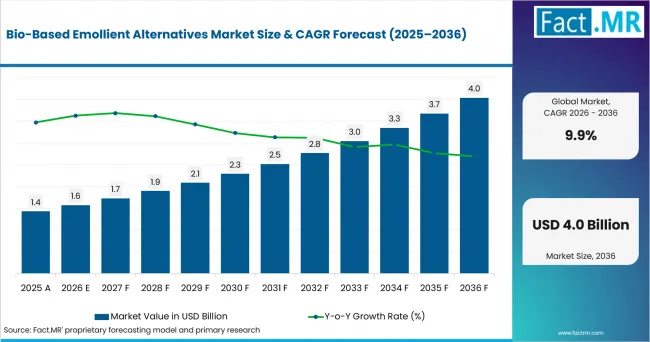
Skin care leads Personal Care Application at 43.00%; Vegetable oils lead Feedstock at 39.00%.
Which Emollient Chemistry segment leads?
Natural esters are expected to hold 34.00% share in 2026.
Bio Based Emollient Alternatives Market Analysis By Emollient Chemistry | Source: Fact.MR
Natural esters lead because they offer a practical replacement path for mineral oils and silicone-like ingredients. Their adjustable afterfeel helps formulators preserve familiar product behavior during reformulation.
Evonik highlighted TEGOSOFT® BC MB at in-cosmetics Global 2025 as a natural emollient produced through an eco-efficient enzymatic process. In April 2025, the company stated that enzymatic emollient production can reduce the climate footprint by more than 60% compared with a chemical process, providing a quantified sustainability benchmark for ester-based emollient production.
What leads the Feedstock segment?
Vegetable oils are projected to account for 39.00% share in 2026.
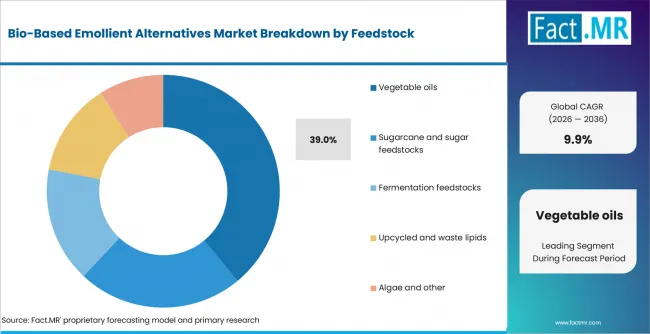
Bio Based Emollient Alternatives Market Analysis By Feedstock | Source: Fact.MR
Vegetable oils lead feedstock selection because oleochemical processors already convert them into esters, squalane inputs and specialty lipids. Their broad industrial base supports scale for ingredient makers using renewable lipid streams while still requiring tight odor and color control.
Vegetable feedstocks also fit certification routes that brands recognize. Their familiar INCI paths help brands compare replacement textures against existing ester systems during pilot formulation work.
How does Sensory Profile shape demand?
Light and dry touch is anticipated to capture 31.00% share in 2026.
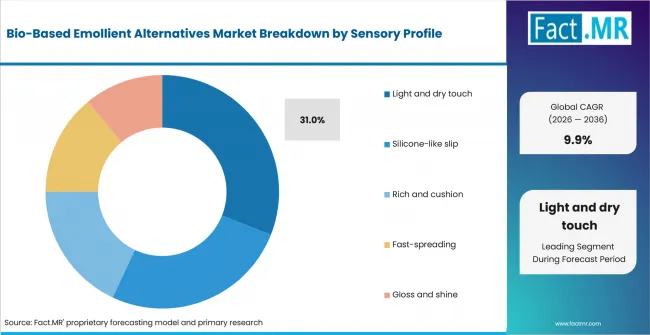
Bio Based Emollient Alternatives Market Analysis By Sensory Profile | Source: Fact.MR
Light and dry touch leads because users quickly notice oiliness, drag and residue in leave-on products. The profile fits face creams, sunscreen fluids, serums and hair oils where a fast spread improves the first-use impression. Suppliers selling squalane oil benefit when their materials replicate silicone-like slip with lower residue.
Croda identifies Crodamol GTS as a bio-based emollient and the 2025 C&T Allē Award winner for Best Base Cosmetic Ingredient for Hair/Scalp Care. The product’s positioning around hair smoothness, shine and skincare sensory attributes reinforces Croda Beauty’s role in bio-based sensory alternatives for hair and skin care.
What supports Skin care within Personal Care Application?
Skin care is estimated to represent 43.00% share in 2026.
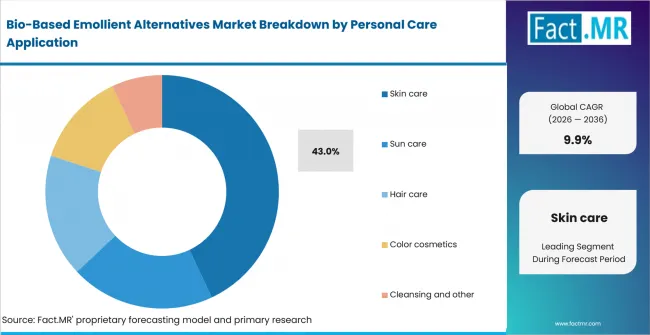
Bio Based Emollient Alternatives Market Analysis By Personal Care Application | Source: Fact.MR
Skin care leads application demand because moisturizers, serums and face oils place emollients directly against user expectations for softness and quick absorption. Leave-on formats make natural-origin claims more visible on labels, so skin care ingredients need sensory proof and clear ingredient documentation.
Sophim reported in April 2025 that Phytosqualan is produced from olive oil industry co-products and is 100% plant-based squalane. Its olive-derived, upcycled origin and lightweight, non-greasy sensoriality support its positioning in premium facial care and hair care formulations where natural origin, performance and transparency influence ingredient selection.