Blog
Pet Food Ingredients & Sustainable Protein Market

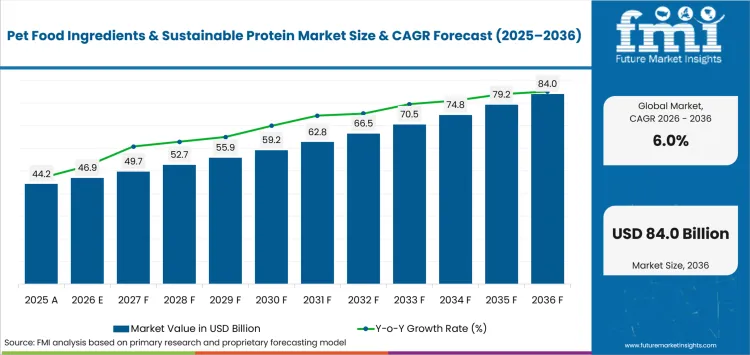
- Market Size (2026)
- USD 46.9 Bn
- Forecast (2036)
- USD 84.0 Bn
- CAGR (2026 to 2036)
- 6.0%
How big is Pet Food Ingredients & Sustainable Protein Market in 2026?
USD 46.9 billion in 2026 and USD 84.0 billion by 2036 at a 6.0% CAGR.
Demand for pet-food ingredients & sustainable protein is projected to expand at 6.0% CAGR between 2026 and 2036, increasing valuation from USD 46.9 billion in 2026 to USD 84.0 billion by 2036. Pet-food manufacturers depend on stable ingredient supply chains to support high-volume production across dry, wet and specialized nutrition products. FEDIAF reported European pet-food production of about 8.6 million tonnes in 2024. The industry’s production scale creates ongoing purchasing requirements for protein ingredients and alternative nutrition sources, supporting recurring demand alongside sustainability-driven reformulation programs.
Country demand diverges as local production scale and ingredient rules change the commercial threshold for new proteins. The China Feed Industry Association reported in February 2026 that pet-feed output reached 1.884 million tonnes in 2025 and rose 17.9%. That production increase raises the value of locally documented ingredients and mature European markets place more weight on repeatability and delivered cost.
Key Takeaways
- Pet-food manufacturers broaden protein sourcing as recurring production requires dependable nutrition plus palatability and supply continuity.
- Based on ingredient, animal protein is projected to account for 47.7% in 2026 due to established nutrition specifications and familiar sourcing routes.
- Dry is set to lead the product category with 46.3% share in 2026 due to scalable extrusion and shelf-stable distribution.
- By claim, sustainable is forecast to represent 64.3% in 2026 driven by traceability requirements entering ingredient qualification.
- Novel proteins face regulatory and formulation gates that extend qualification timelines ahead of regular commercial purchasing.
- Mars Petcare, Nestlé Purina, ADM, Cargill, Protix, Hill’s Pet Nutrition, Symrise Pet Food and Bond Pet Foods are some key players.
Analyst Perspective
“Pet-food brands approve unfamiliar proteins once legal review and feeding trials confirm performance inside the intended recipe. Ingredient producers earn repeat orders by holding nutrition specifications steady and supplying traceable volumes across scheduled manufacturing runs.”
– , Principal Consultant, Future Market Insights
How is the pet food ingredients & sustainable protein market segmented?
The pet food ingredients & sustainable protein market is segmented by ingredient, product, claim and region.
The pet food ingredients & sustainable protein market is segmented by ingredient, product, claim and region. Ingredient categories include animal protein, insect, plant and novel sources, while product categories cover dry, wet and treats. Claim categories distinguish sustainable from functional positioning, and region follows the standard FMI geographic taxonomy used throughout the report.
What makes animal protein central to the ingredient category?
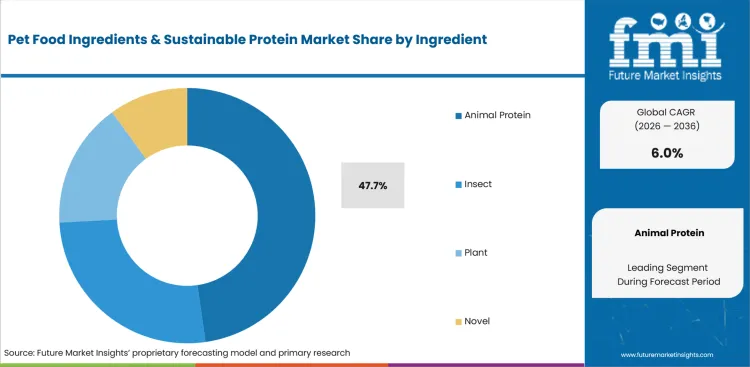
Across pet food ingredients, animal protein remains the formulation reference as pet-food formulators understand its amino-acid contribution and palatability behavior. Mars reported in March 2026 that ORIJEN FRESHPREY recipes use fresh or raw animal ingredients. Fresh and raw animal materials occupy the first five ingredient positions across those commercial recipes.
- By ingredient, animal protein is estimated to hold 47.7% in 2026 owing to established specifications and broad commercial sourcing.
- Established meat supply chains provide protein ingredients at commercial volume for repeat formulas across major pet-food brands. Alternative sources enter more readily as complements once they preserve nutritional adequacy and acceptable taste during commercial feeding.
Why does dry remain the leading product category?
Dry formulas concentrate ingredient demand inside extrusion systems that reward stable nutrient composition and predictable processing behavior across packaged pet food runs. Unlike dehydrated pet food formats, extruded kibble exposes proteins to heat and shear that can disrupt structure as composition varies.
- In 2026, dry is expected to lead the product category with 46.3% share due to scalable extrusion and shelf-stable distribution.
- Mars opened Royal Canin’s Lewisburg dry pet-food facility in May 2025 with annual output sufficient to feed four million pets. That scale favors protein ingredients that tolerate extrusion heat and shear without disrupting kibble structure or shelf stability.
How does sustainable lead within the claim category?
Sustainable claims affect ingredient approval as sourcing evidence must meet nutrition and processing requirements across alternative proteins. Plant-based protein remains viable once nutrition and supply requirements fit the intended recipe.
- The claim category is forecast to be led by sustainable at 64.3% share in 2026 due to traceability entering ingredient qualification. Mars Petcare and Big Idea Ventures launched the Next Generation Pet Food Program in May 2026 to scout alternative proteins and novel ingredients.
- Insect-protein pet food developers compare lower-impact inputs with conventional proteins once nutrition specifications remain stable across recipes. Supply continuity determines whether unfamiliar proteins advance from qualification into recurring commercial production.
What are the drivers, restraints and opportunities in the Pet Food Ingredients & Sustainable Protein Market?
Recurring pet-food production sustains ingredient demand, qualification requirements slow substitution and validated alternative proteins offer a practical second-source route.
- Driver: Recurring pet-food output ties protein and functional ingredient purchases to scheduled manufacturing runs throughout the year.
- Restraint: Unfamiliar ingredients must clear legal review and pet-specific formulation tests ahead of recurring-volume commitments from manufacturers.
- Opportunity: Alternative proteins can secure second-source positions once regulatory and feeding evidence supports repeat commercial use.
Scaled Pet-Food Production Sustains Recurring Ingredient Orders
Pet-food plants require dependable protein and functional ingredient volumes across repeated dog food and cat-food production runs throughout the year. The Pet Food Institute reported in April 2025 that USA manufacturers produced 9.8 million tons of pet food in 2024 using more than 600 ingredients. Production at that scale turns specification consistency into a recurring purchasing requirement as protein changes can affect nutrition, process behavior and approved finished recipes.
Ingredient Review Extends Novel Protein Qualification
Novel proteins enter commercial formulas slowly as manufacturers must establish legal status and intended use ahead of larger purchase volumes. FDA issued final Animal Food Ingredient Consultation guidance in July 2025 for firms seeking agency feedback on new animal-food ingredients. That review route adds documentation work early in development and makes regulatory planning part of account qualification ahead of brand-level feeding trials.
Validated Alternative Proteins Can Secure Second-Source Roles
Alternative proteins gain a commercial route once safety and feeding evidence support use in established pet-food formulas. Hill’s Pet Nutrition and Bond Pet Foods reported in May 2026 that FDA issued a no-objection letter for Lamb Protein Yeast following a six-month dog feeding study. The milestone gives precision fermentation ingredient developers a concrete qualification sequence from feeding evidence to manufacturer trials and repeat ingredient orders.
Which country CAGRs are profiled in the Pet Food Ingredients & Sustainable Protein Market?
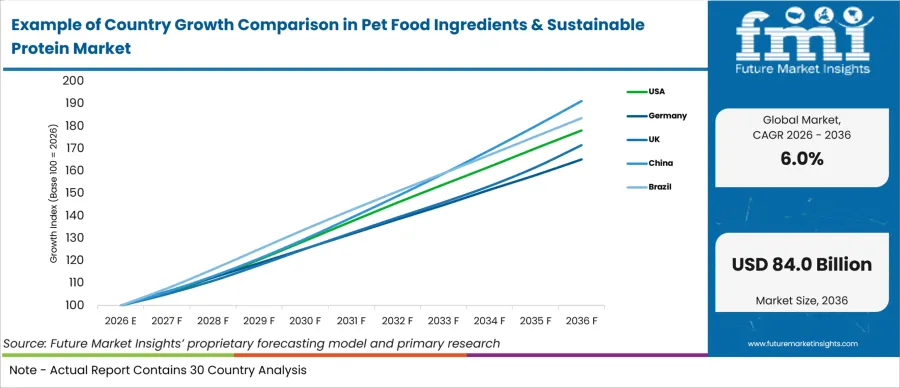
| Country | CAGR |
|---|---|
| China | 6.7% |
| Brazil | 6.3% |
| United States | 5.9% |
| United Kingdom | 5.5% |
| Germany | 5.1% |
How do country-level CAGRs compare in the Pet Food Ingredients & Sustainable Protein Market?
The 1.6 percentage-point range separates China and Brazil from a slower European pair without creating a growth divide. The United States sits between them as commercial scale meets formal ingredient review. The pattern points to different qualification economics and production conditions rather than a ranking of current market size.
- China combines rising pet-feed output with licensing that rewards locally documented proteins.
- Brazil combines domestic co-products with taxation that keeps delivered ingredient costs visible.
- United States formulators use FDA consultation as an early gate for unfamiliar proteins.
- United Kingdom brands face retailer scrutiny over traceable nutrition and dependable supply.
- Germany’s prepared-food channels make recipe costs visible during commercial ingredient qualification programs.
Comparable rates mask different qualification timelines and delivered-cost pressures across these five markets. The full report provides country-level CAGR analysis across North America, Latin America, Europe, East Asia, South Asia, Oceania and the Middle East and Africa.
Country-wise Analysis
- Chinese pet-food manufacturers work within a licensing system that separates domestic production approval from import registration for finished pet-feed products. The ministry also requires product labeling and safety documentation, which raises preparation work for unfamiliar proteins entering commercial formulas. China’s pet food ingredients & sustainable protein outlook is anticipated to advance at 6.7% CAGR over the assessment period, aided by higher-value formulas. The Ministry of Agriculture and Rural Affairs stated in September 2025 that six regulatory documents govern pet-feed production and oversight. Clearer rules give compliant ingredient firms a defined entry route, but frequent product launches reward local technical support and dependable supply.
- Brazilian pet-food manufacturers can source animal co-products locally, but high taxes and inflation make delivered ingredient cost visible during reformulation decisions. ABEMPET reported in October 2025 that national pet-food production was forecast to decline 3.9% as inflation and currency pressure weakened category economics. Local protein availability reduces import dependence for conventional inputs, although unfamiliar alternatives must protect nutrition specifications and finished-food pricing across mainstream channels. Pet food ingredients & sustainable protein sales in Brazil are forecast to expand at 6.3% CAGR by 2036, supported by domestic production and established processing. Alternative-protein developers therefore need lower delivered cost and traceable supply records to secure routine purchasing from major brands.
- United States formulators separate ingredient eligibility from brand-level feeding evidence during review of new proteins for national dog and cat food recipes. FDA’s November 2025 response closed Hill’s consultation for rice protein concentrate following review of manufacturing controls and feeding evidence for intended use. The federal consultation route gives developers a defined regulator contact point, but completed review does not replace palatability or commercial process testing. Pet food ingredients & sustainable protein demand in the United States is forecast to rise at 5.9% CAGR over the forecast period. New entrants need regulatory files plus pet-specific performance data to convert brand trials into recurring ingredient purchases.
- United Kingdom pet-food brands sell into dense grocery and specialty channels that expose reformulation quickly in shelf pricing and retailer discussions. Established national distribution gives ingredient firms access to repeat programs, although unfamiliar proteins must justify higher cost and traceable sourcing. UK Pet Food reported in March 2026 that 62% of households owned a pet, sustaining a broad recurring base for branded production. Adoption of pet food ingredients & sustainable protein in the United Kingdom is estimated to expand at 5.5% CAGR through 2036. Commercial conversion therefore favors companies that pair dependable availability with application support across scheduled manufacturing cycles and national retail accounts.
- German pet-food manufacturers sell through mature grocery and specialty channels that expose formulation changes to immediate price comparison across national brands. Germany is estimated to post 5.1% CAGR over the forecast period, as established prepared-food production keeps recurring ingredient demand comparatively stable. ZZF reported in April 2026 that dry dog-food sales declined 2.7% during 2025, reinforcing price sensitivity across mainstream pet-food purchasing. Experienced manufacturers offer clear qualification routes for proven proteins, but unfamiliar ingredients must pair stable specifications with transparent origin data. Those requirements make recipe economics and repeatability central to supplier selection across established retail programs and private-label accounts.
Who are the notable companies in the Pet Food Ingredients & Sustainable Protein Market?
Mars Petcare, Nestlé Purina, ADM, Cargill, Protix, Hill’s Pet Nutrition, Symrise Pet Food and Bond Pet Foods are the notable companies serving this market.
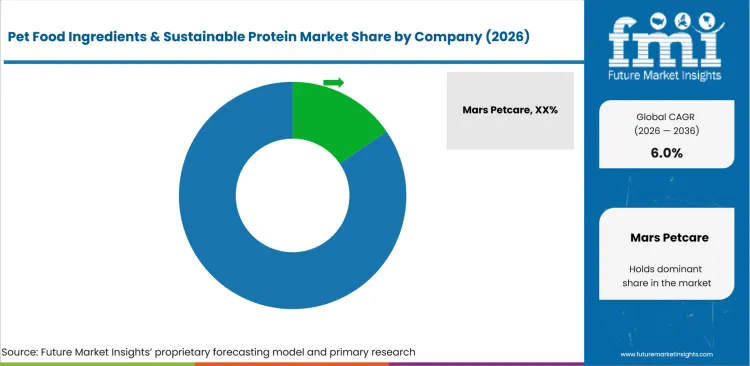
Competition spans branded pet-food formulators, ingredient platforms and specialist protein developers that enter recipes at different approval points. Branded manufacturers control finished-recipe validation as ingredient firms compete for specification access. Legal status and repeatable performance must precede regular purchasing, which raises entry barriers for unfamiliar proteins.
- Mars Petcare, Nestlé Purina and Hill’s Pet Nutrition shape branded specifications by setting recipe requirements for pet food palatants and protein evidence.
- ADM and Symrise Pet Food provide formulation support across established commercial pet-food programs, and Cargill documented pet-nutrition participation in its July 2025 China supply-chain showcase.
- Protix and Bond Pet Foods specialize in alternative proteins whose access depends on regulatory progress and repeatable commercial production.
Competitive Benchmarking: Pet Food Ingredients & Sustainable Protein Market
| Company | Pet-Food Formulation Integration | Alternative Protein Commercialization | Ingredient Validation and Scale-Up | Geographic Reach |
|---|---|---|---|---|
| Mars Petcare | High | Medium | High | Global |
| Nestlé Purina | High | Medium | High | Global |
| ADM | Medium | Medium | High | Global |
| Cargill | Medium | Medium | Medium | Global |
| Protix | Low | High | High | Europe with North American expansion |
| Hill’s Pet Nutrition | High | High | High | North America and international markets |
| Symrise Pet Food | Medium | Medium | High | Global pet-food operations |
| Bond Pet Foods | Low | High | High | North America with partner-led commercialization |
Scoring basis: High formulation integration requires finished-recipe control plus commercial manufacturing evidence, with Medium reserved for application support and Low for an ingredient-specific role. High alternative-protein commercialization requires completed pet-food use or regulatory clearance, compared with documented development at Medium and a conventional portfolio at Low. A High validation and scale-up score requires pet-specific testing plus commercial production, while Medium requires one verified element and Low requires neither within a narrow role. Geographic reach remains descriptive, and ratings use company newsrooms plus regulator records instead of company size or reputation.
Key Developments in the Pet Food Ingredients & Sustainable Protein Market
- In May 2026, Nestlé Purina announced an August grand opening for its USD 550 million Batavia pet-food factory as the site transitioned to full production.
- In April 2026, Symrise invested in Bond Pet Foods and began co-developing precision-fermented animal-identical proteins for pet-nutrition applications.
- In January 2025, ADM reported a 28-day controlled study involving 24 cats that evaluated postbiotic and fiber ingredients across a diet change.
Key Players in the Pet Food Ingredients & Sustainable Protein Market
Integrated Pet Nutrition Formulators
- Mars Petcare
- Nestlé Purina
- Hill’s Pet Nutrition
Ingredient and Formulation Platforms
- ADM
- Cargill
- Symrise Pet Food
Alternative Protein Specialists
Pet Food Ingredients & Sustainable Protein Market – Report Scope
| Coverage field | Report scope |
|---|---|
| Market breakdown | By ingredient, product, claim and region. |
| Quantitative Units | USD billion. |
| Market Definition | Commercial ingredients and protein systems supplied for formulated pet foods and treats across conventional or alternative protein routes. |
| Regions Covered | North America, Latin America, Europe, East Asia, South Asia and Pacific and Middle East and Africa. |
| Countries Covered | China, Brazil, United States, United Kingdom, Germany, and 20+ countries included in the full report. |
| Key Companies Profiled | Mars Petcare, Nestlé Purina, ADM, Cargill, Protix, Hill’s Pet Nutrition, Symrise Pet Food, Bond Pet Foods. |
| Forecast Period | 2026 to 2036. |
| Approach | Primary and secondary research with market triangulation. |
Pet Food Ingredients & Sustainable Protein Market – Research Methodology
| Method | Approach |
|---|---|
| Primary Research | FMI analysts gathered input from manufacturers, service providers, technology developers, distributors, end users, procurement teams, and subject-matter experts. Interviews examined purchasing decisions, product or service evaluation, adoption barriers, approval requirements, pricing considerations, and expectations for technical or commercial support. Respondents were also asked what evidence is required before a trial, pilot, or initial order develops into regular purchasing. |
| Desk Research | Desk research covered government statistics, regulatory publications, trade data, industry associations, technical literature, standards, company filings, product information, and official corporate announcements. Sources were reviewed for relevance, publication date, geographic coverage, and consistency with the defined market scope. Claims relating to performance, applications, approvals, capacity, investment, and commercial activity were retained only when supported by credible public evidence. |
| Market Sizing and Forecasting | The market model combined the baseline value with historical performance, segment structure, pricing and volume indicators, adoption levels, company participation, and country-level demand conditions. Forecast assumptions considered economic activity, investment trends, regulatory developments, technology adoption, purchasing cycles, supply availability, and barriers to wider market use. Segment and regional estimates were reconciled before the final market total was calculated. |
| Data Validation | Estimates were checked against multiple independent indicators, including public data, company activity, trade patterns, industry developments, and findings from primary interviews. Validation also tested whether products, services, applications, and company revenues fell within the defined market boundaries. Adjacent categories, unsupported claims, overlapping revenues, and activities without direct market relevance were excluded to reduce double counting and maintain consistency across segments and countries. |
Pet Food Ingredients & Sustainable Protein Market by Segments
Pet Food Ingredients & Sustainable Protein Market segmented by Ingredient:
- Animal Protein
- Insect
- Plant
- Novel
Pet Food Ingredients & Sustainable Protein Market segmented by Product:
Pet Food Ingredients & Sustainable Protein Market segmented by Claim:
Pet Food Ingredients & Sustainable Protein Market by Region:
- North America
- Latin America
- Brazil
- Mexico
- Chile
- Rest of Latin America
- Western Europe
- Germany
- United Kingdom
- Italy
- Spain
- France
- Nordics
- Benelux
- Rest of Western Europe
- Eastern Europe
- Russia
- Poland
- Hungary
- Balkan and Baltic States
- Rest of Eastern Europe
- East Asia
- South Asia and Pacific
- India
- ASEAN
- Australia and New Zealand
- Rest of South Asia and Pacific
- Middle East and Africa
- Kingdom of Saudi Arabia
- Other GCC Countries
- Türkiye
- South Africa
- Other African Union Countries
- Rest of Middle East and Africa
Research Sources and Bibliography
- FEDIAF. (2026, June). European pet population and market data 2024.
- China Feed Industry Association. (2026, February 6).
- Mars, Incorporated. (2026, March 5). ORIJEN™ unleashes FRESHPREY elevating fresh pet food to new heights.
- Mars, Incorporated. (2025, May 14). Mars builds on long-term USA investment with the opening of new $450 million Royal Canin facility in Ohio.
- Mars, Incorporated. (2026, May 12). Big Idea Ventures and Mars Petcare launch 2026 Global Pet Food Innovation Program in collaboration with AAK, Bühler, Givaudan, and Ingredion.
- Pet Food Institute. (2025, April 7). Feeding Pets, Fueling the Economy: 600+ Ingredients Drive $51.7B Pet Food Sales, According to New IFEEDER Report.
- USA Food and Drug Administration. (2025, July). CVM GFI #294 – Animal Food Ingredient Consultation (AFIC).
- Hill’s Pet Nutrition. (2026, May 12). Hill’s Pet Nutrition and Bond Pet Foods Receive FDA No-Objection Letter for First Animal Protein Produced via Precision Fermentation for Pet Food.
- Ministry of Agriculture and Rural Affairs of China. (2025, September 10).
- ABEMPET. (2025, October 27). No digital, o varejo especializado mantém a liderança.
- USA Food and Drug Administration. (2025, November 14). Animal Food Ingredient Consultation 0001-Rice Protein Concentrate.
- UK Pet Food. (2026, March 31). Britain’s dog ownership boom as 15.5 million dogs now live in UK homes.
- ZZF. (2026, April 23). Der Deutsche Heimtiermarkt 2025.
- Cargill. (2025, July 16). Cargill Demonstrates Full-Chain Strength at the 3rd CISCE.
- Nestlé Purina PetCare. (2026, May 26). Purina Announces Grand Opening for New Ohio Pet Food Factory.
- Symrise. (2026, April 15). Symrise invests in Bond Pet Foods to accelerate sustainable innovation in pet nutrition via precision fermentation.
- ADM. (2025, January 29). ADM Pioneers Groundbreaking Study Demonstrating Improvements in Cat Digestive Health.
- Symrise Pet Food. (2026, February 25). Symrise Pet Food inaugurates a new facility in Querétaro, Mexico.
- Mars, Incorporated. (2026, July 14). Royal Canin® launches its first fresh therapeutic diet portfolio, available exclusively through veterinarians.
- Hill’s Pet Nutrition. (2026, June 30). Hill’s Pet Nutrition Rolls Out Science Diet Single Protein Refrigerated Dog Food.
- Protix. (2026). Explore our paw-some pet food ingredients. Retrieved August 13, 2026.
- ADM. (2026). Pet Nutrition. Retrieved August 13, 2026.
- Cargill. (2026). Pet Nutrition & Health. Retrieved August 13, 2026.
- Symrise Pet Food. (2026). Our locations. Retrieved August 13, 2026.
- Nestlé Purina PetCare. (2025, January 15). Purina Awards $125,000 to Five USA-Based Pet Startups through 2025 Pet Care Innovation Prize.
- Protix. (2025, October 28). Protix’s strong sustainability data confirmed by peer review.
This bibliography is provided for reader reference and is not exhaustive. The full report contains the complete reference list and detailed citations
This Report Answers
- How large is the pet food ingredients market in 2026 and 2036?
- What operating conditions sustain recurring protein ingredient demand?
- Why does animal protein retain the largest ingredient share?
- How does dry processing shape protein supplier specifications?
- Why do traceability requirements affect sustainable protein qualification?
- Which rules slow adoption of novel proteins?
- How do country growth rates reflect local qualification conditions?
- Which company types compete across formulation and alternative proteins?
- What evidence moves new proteins from trials into repeat purchasing?
Frequently Asked Questions
How big is the pet food ingredients & sustainable protein market in 2026?
The pet food ingredients & sustainable protein market is valued at USD 46.9 billion in 2026 and is projected to reach USD 84.0 billion by 2036. Growth is driven by rising pet-food production and increasing demand for sustainable and traceable protein ingredients.
What is the CAGR of the pet food ingredients & sustainable protein market from 2026 to 2036?
The pet food ingredients & sustainable protein market is projected to grow at a CAGR of 6.0% between 2026 and 2036. Expansion is supported by ongoing protein diversification efforts while maintaining nutritional quality and supply-chain reliability.
Which ingredient leads the pet food ingredients & sustainable protein market?
Animal protein is projected to account for 47.7% of the market in 2026. Its leading share is supported by established nutritional standards, broad commercial availability, and strong adoption across pet-food formulations.
How much value will the pet food ingredients & sustainable protein market add between 2026 and 2036?
The pet food ingredients & sustainable protein market is expected to add USD 37.1 billion in value between 2026 and 2036. Growth reflects continued pet-food production and increasing qualification of sustainable protein sources across the industry.
Which companies are active in the pet food ingredients & sustainable protein market?
Key companies operating in the market include Mars Petcare, Nestlé Purina, ADM, Cargill, Protix, Bond Pet Foods, Hill’s Pet Nutrition, and Symrise Pet Food. These companies compete through protein innovation, ingredient sourcing capabilities, and formulation expertise.
Preview the report firsthand – request a free sample
Get Sample
Get the brochure for pricing and purchase details.
Get PDF