Blog
North America Pet Grooming Products Market Size, Report-2035

North America Pet Grooming Products Market Size
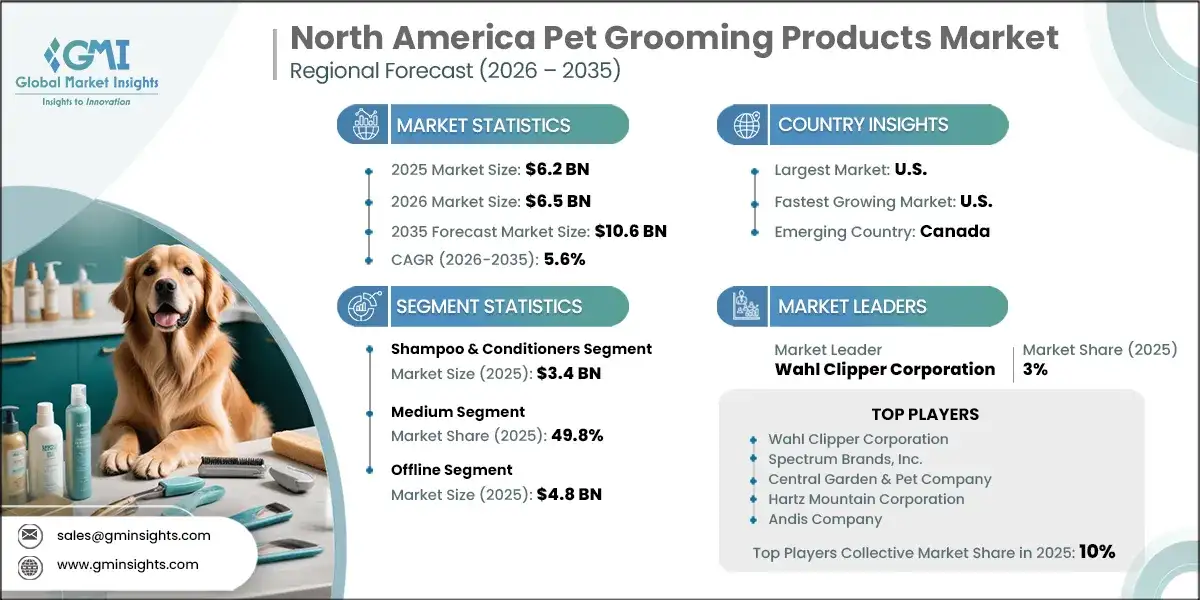
The North America pet grooming products market was estimated at USD 6.2 billion in 2025. The market is expected to grow from USD 6.5 billion in 2026 to USD 10.6 billion in 2035, at a CAGR of 5.6% according to latest report published by Global Market Insights Inc.
North America Pet Grooming Products Market Key Takeaways
2025 Market Size
$ 6.2 Billion
2026 Market Size
$ 6.5 Billion
2035 Forecast Market Size
$ 10.6 Billion
Regional Dominance
Fastest Growing Country
U.S.
Key Players
-
Market Leader: Wahl Clipper Corporation led with over 3% market share in 2025.
-
Leading Players: Top 5 players in this market include Wahl Clipper Corporation, Spectrum Brands, Inc., Central Garden & Pet Company, Hartz Mountain Corporation, Andis Company, which collectively held a market share of 10% in 2025.
Key Market Drivers
- Increasing pet humanization
- Growing focus on pet health & hygiene
- Premiumization of pet care
Opportunity
- Natural & organic grooming products
- Personalized grooming solutions
Challenges
- Intense market competition
- Product safety concerns
Get Market Insights & Growth Opportunities
Download Free PDF
The continued expansion of the market is anchored in the deepening humanization of companion animals across the United States and Canada. Pet ownership has evolved from a functional household arrangement into a deeply personal lifestyle commitment, with owners applying the same quality and safety standards to pet care that they apply to their own grooming and wellness routines. Total U.S. pet industry expenditures reached USD 158 billion in 2025, with 95 million U.S. households owning at least one pet, reflecting the scale of the addressable consumer base and the resilience of category spending across economic cycles.[1]
Data from the American Veterinary Medical Association confirms that 42.6% of U.S. households own dogs representing 56.3 million dog-owning households while 32.6% own cats across 43.1 million households, together forming the primary domestic target market for grooming consumables and tools.[2] As companion animals are increasingly treated as family members, the frequency and quality threshold of grooming product purchases have risen in parallel, with owners extending the same ingredient and brand criteria to pet care that govern their own personal care choices.
A defining structural characteristic of the current market phase is the integration of grooming into the broader pet wellness paradigm. Consumers across North America are repositioning at-home grooming routines as proactive health maintenance activities rather than cosmetic conveniences, creating sustained demand for products with dermatological and functional credentials including medicated shampoos, skin-soothing conditioners, paw-barrier balms with anti-inflammatory actives, and dental hygiene wipes. In our Q3 2025 survey of 280 pet specialty retailers across the U.S. and Canada, 67% reported an increase in consumer-driven demand for clean-label or naturally formulated grooming products compared to two years prior, with 44% having allocated more than 20% of their grooming shelf space to certified-natural or free-from formulations. This wellness orientation is directly reinforcing repeat purchase behaviour and supporting above-average growth rates in the shampoos and conditioners segment the market’s largest product category.
Premiumization is a complementary structural driver reshaping the market’s value composition. Younger generations particularly Gen Z and Millennials, now the fastest-growing pet-owning cohort in North America are allocating proportionally higher spending to premium grooming products and extending the professional-grade quality standards previously confined to grooming salons into the at-home consumer market. Supply chain leads interviewed across 12 major U.S. and Canadian pet specialty and mass retail buyers in H1 2025 indicated that 58% are actively expanding their premium and clean-label grooming shelf allocations, with dedicated endcap and gondola fixtures for natural brands becoming standard across the three largest U.S. pet specialty chains. This retail-level commitment to premiumization is translating into sustained average selling price increases across multiple product categories and supporting the market’s consistent year-on-year revenue growth.
The North American market benefits from a mature and well-distributed retail infrastructure that provides wide product access across all consumer segments, price tiers, and geographic markets. Pet specialty chains, mass merchandisers, veterinary distribution channels, and e-commerce platforms collectively serve the full spectrum of product needs, ensuring consistent on-shelf availability for both established national brands and emerging specialty or natural products.
To get key market trends
Download Free PDF
North America Pet Grooming Products Market Trends
The North America pet grooming products industry is transitioning from a commodity-driven, hygiene-focused category into a multi-dimensional consumer segment shaped by wellness priorities, ingredient consciousness, and lifestyle-driven purchasing. Consumer expectations have elevated across all product types shampoos, tools, and accessories alike and the pace of product innovation has accelerated in response to a demographically younger and more engaged pet-owning population.
- The clean label movement, which reshaped the human personal care market over the prior decade, has fully migrated into pet grooming. Consumers are actively seeking products free from sulphates, parabens, artificial fragrances, and synthetic colorants, and brands without a credible ingredient transparency narrative are experiencing accelerating shelf-placement resistance from specialty retailers. Under the FDA’s compliance policy CPG Sec. 653.100, animal grooming aids intended solely to cleanse or beautify animals are classified separately from animal drugs, establishing a clear regulatory boundary that incentivizes clean-label manufacturers to remain within the cosmetic grooming aid category while deploying ingredient transparency as a primary commercial differentiator.[3] Brands such as 4Legger and Earthbath have built their entire product architectures around this positioning, with audited organic certifications and free-from ingredient decks that resonate with the health-conscious ownership segment.
- Wellness-driven grooming is emerging as the most consequential behavioural shift in the category. Pet owners are integrating grooming into preventive health routines, creating demand for products that deliver dermatological, dental, and skin-barrier benefits alongside cosmetic outcomes. Formulations featuring oatmeal, aloe vera, omega-enriched botanical oils, and enzymatic actives are gaining disproportionate shelf prominence, as manufacturers bridge the cosmetic and veterinary positioning that wellness-oriented consumers increasingly expect. This trend is also directly supporting the growth of nail care products and grooming wipes and sprays, which offer between-bath health maintenance functions that align with the health-first ownership mindset.
- The premiumization of pet grooming is accelerating beyond professional grooming communities into mainstream consumer retail. Professional-grade products historically distributed through veterinary clinics and grooming salons are now accessible through pet specialty retail chains and DTC platforms, normalizing elevated price points for at-home grooming. The FTC’s truth-in-advertising framework requires brands to substantiate clinical-grade or veterinary-strength labelling claims, creating a compliance environment that systematically rewards established brands with documented product efficacy over unverified new entrants and reinforcing the value premium for credentialed products.[4]
- The online retail channel is emerging as a growth accelerator for the consumables segment. Subscription-based replenishment models for shampoos, grooming wipes, and sprays are gaining traction on Chewy and brand-owned DTC platforms, providing more predictable revenue streams for manufacturers and reinforcing brand loyalty through auto-ship convenience. The EPA’s regulatory framework for grooming products containing active pesticide ingredients including flea and tick shampoos requires registration and full label compliance, creating a quality and safety floor that supports consumer trust in established channel-stocked brands over unregulated alternatives.[5]
North America Pet Grooming Products Market Analysis
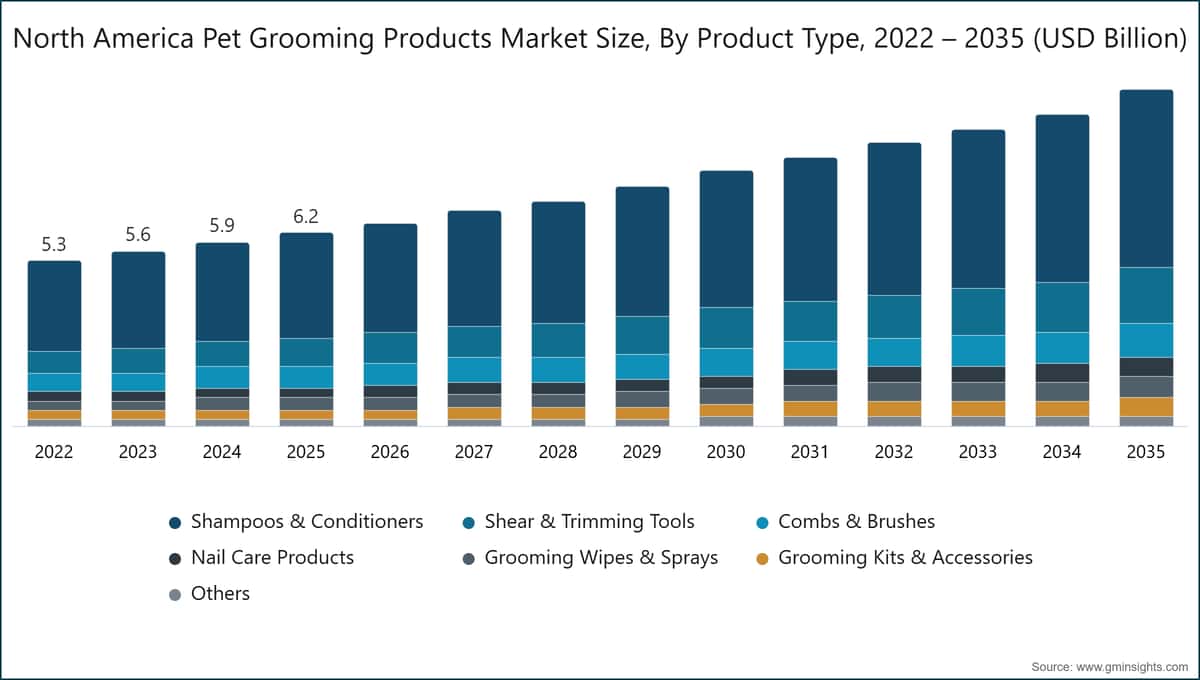
Based on product type, the North America pet grooming products market is divided into shampoos & conditioners, shear & trimming tools, combs & brushes, nail care products, grooming wipes & sprays, grooming kits & accessories and others. In 2025, shampoos & conditioners held the major market share, generating a revenue of USD 3.4 billion.
- Shampoos and conditioners represent the core recurring consumable within the North American pet grooming routine, purchased at higher frequency than any other product category and subject to continuous innovation in formulation chemistry and positioning. The segment’s dominance is sustained by both its functional essentiality every pet-owning household requires a cleansing product and by the depth of product differentiation available across the price spectrum. At the segment level, the most consequential development of the current market cycle is the fragmentation of the traditional one-size-fits-all shampoo SKU into breed-specific, age-specific, skin condition-specific, and wellness-oriented sub-categories.
- TropiClean’s portfolio of more than 15 distinct shampoo formulations covers age-appropriate puppy lines, medicated solutions for seborrhoea and hot spots, and oatmeal-based formulas for sensitive skin demonstrating how manufacturers capture incremental shelf space through need-state segmentation. Earthbath similarly deploys a multi-variant architecture covering tearless, whitening, hypoallergenic, and deodorizing formulations, each targeting a distinct consumer need. The growing clean-label orientation within this segment with consumers actively requesting sulphate-free, paraben-free, and naturally sourced formulations has elevated average selling prices at the mid-premium tier, supporting above-average revenue growth within the market’s dominant category.
Learn more about the key segments shaping this market
Download Free PDF
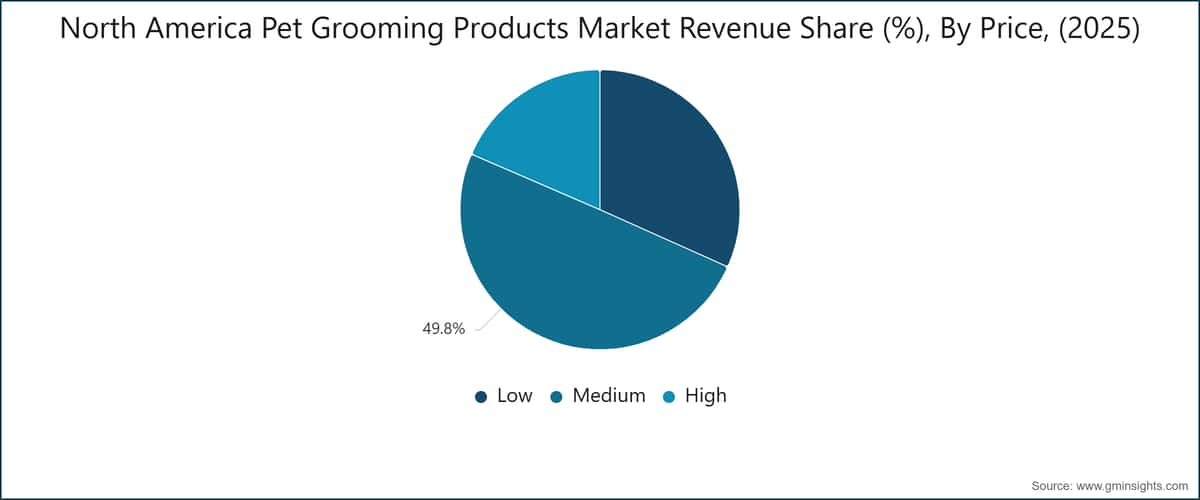
Based on price, the North America pet grooming products market is segmented into low, medium and high. The medium segment held the largest share, accounting for 49.8% of the market in 2025.
- The medium price tier occupies the largest market position within the North America pet grooming products industry, representing the broadest consumer addressable market. This tier is anchored by nationally distributed, recognizable brands that balance formulation quality with accessible price points with products such as TropiClean’s Berry Fresh and Oatmeal & Tea Tree shampoos and Hartz Mountain’s GROOMER’S BEST conditioning shampoo line serving as representative volume drivers. The medium segment appeals to the mainstream pet-owning population consumers who prioritize ingredient quality and brand trust but are not yet committed to the luxury or clinical-grade positioning of the high-price tier. At the segment level, the most significant structural development within the medium tier is the clean-label migration: brands that previously occupied commodity price positions are reformulating with free-from ingredient decks and botanical actives to retain shelf relevance in a market where consumer ingredient scrutiny is no longer confined to premium buyers.
- This migration is compressing the price gap between medium-tier and premium-tier products while simultaneously upgrading the formulation quality floor of the overall market. The medium tier is also the primary beneficiary of online subscription replenishment, with auto-ship discounts and subscription pricing models creating consumer lock-in for high-frequency consumables at this price point. Our survey of 175 independent pet specialty retailers across 22 U.S. states and four Canadian provinces in Q2 2025 found that brand heritage and veterinary endorsement were cited by 61% of respondents as the top two factors influencing initial product ranging decisions dynamics that favour the established medium-tier brands that have built consumer trust over time.
Based on distribution channel, the North America pet grooming products market is segmented into online booking and offline. In 2025, offline segment held the largest market share, generating a revenue of USD 4.8 billion.
- Offline retail channels continue to dominate distribution within the North America pet grooming products industry, supported by the mature pet specialty and mass retail infrastructure that spans urban, suburban, and rural markets across the United States and Canada. Pet specialty chains remain the primary discovery and purchase environment for grooming products, offering an in-store experience that is particularly critical for tool categories clippers, brushes, combs where tactile evaluation and staff guidance influence purchase decisions. PetSmart, operating approximately 1,650 U.S. locations, and Petco, with approximately 1,500 stores, collectively provide dedicated grooming sections, in-store grooming services that directly drive product cross-sell, and trained staff who reinforce brand credibility for both established and emerging product lines. Mass merchandisers including Walmart and Target serve the high-volume, value-tier segment of the consumer base, while veterinary clinics represent a specialized offline channel for medicated and condition-specific grooming formulations.
- The offline channel’s dominance is particularly pronounced for the shear and trimming tools sub-category, where physical interaction with the product and staff demonstration remain the primary purchase drivers. The depth and geographic coverage of offline retail infrastructure in North America creates a structural advantage for brands with established distribution agreements and shelf placement commitments, sustaining the dominance of the offline channel even as online alternatives expand. Statistics Canada’s household expenditure data indicates consistent year-on-year growth in pet care product spending across major Canadian metropolitan markets, confirming that offline formats remain the primary access channel for grooming product purchases in Canada.[6]
U.S. Pet Grooming Products Market
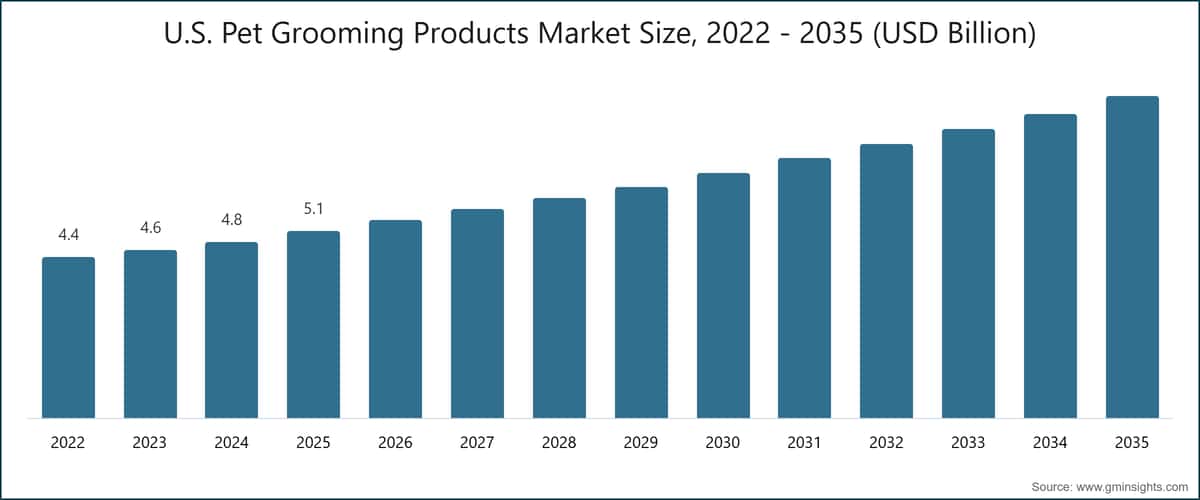
In 2025, the U.S. dominated the North America pet grooming products market, accounting for around 82.1% and generating around USD 5.1 billion revenue in the same year.
- The U.S. is the largest and most structurally advanced market within North America for pet grooming products, characterized by high pet ownership penetration, a mature and competitive retail ecosystem, and elevated per-household discretionary spending on animal care. The breadth of the U.S. consumer base spanning independent pet specialty stores, national chains, veterinary clinics, mass merchandisers, and a well-developed e-commerce infrastructure provides product manufacturers with multiple distribution pathways and diverse consumer access points across all price tiers. Regulatory clarity under the FDA’s compliance policy for animal grooming aids, combined with FTC consumer protection standards on product labelling and advertising claims, creates a well-defined operating environment that supports consistent product quality across the market.
- Fashion and social media trends play a meaningful role in product discovery and adoption within the U.S. market, with platforms such as Instagram and TikTok driving viral adoption of pet care routines, grooming hacks, and branded product preferences particularly among the Gen Z and Millennial pet-owning demographic. Consumer sophistication within the U.S. market continues to advance, with growing segments of the owner population actively researching ingredient lists, seeking third-party certifications, and comparing professional groomer recommendations before making purchase decisions. The American Animal Hospital Association’s pet wellness guidelines, which position routine grooming as a component of preventive health maintenance, have contributed to raising consumer awareness of the functional health benefits of regular grooming product use. [7]
North America Pet Grooming Products Market Share
Wahl Clipper Corporation is leading with 3% market share. Wahl Clipper Corporation, Spectrum Brands, Inc., Central Garden & Pet Company, Hartz Mountain Corporation, Andis Company collectively hold around 10%, indicating a moderately concentrated competitive structure. These prominent players are proactively involved in strategic endeavors, such as mergers & acquisitions, facility expansions, and technology collaborations, to expand their product portfolios, extend their reach to a broad customer base, and strengthen their market position.
Spectrum Brands, Inc. is a well-established entity in the North American pet grooming products market. The company operates through a multi-brand portfolio architecture that spans multiple grooming need-states with FURminator addressing de shedding tools and shampoos, 8in1 covering accessories and grooming supplements, and DreamBone targeting the dental care adjacency. This portfolio breadth allows Spectrum Brands to secure shelf presence across distinct product categories within a single retailer relationship, maximizing its total commercial footprint within the pet grooming space. The company’s ability to serve both mass market and pet specialty channels through a diversified brand architecture represents a structural competitive advantage in a highly fragmented market.
Central Garden & Pet Company competes through category scale and mass retail distribution depth. Operating the Four Paws and Bio Spot Active Care brands, the company has established consistent on-shelf availability across Walmart, Target, and regional mass merchandisers channels that serve the high-volume, value-tier consumer segment driving most of the unit volume in the grooming category. Central Garden & Pet’s inorganic growth history adding brands such as Farnam animal care products to its platform demonstrates a consistent M&A strategy of building category breadth and distribution reach through acquisition rather than organic new product development alone.
North America Pet Grooming Products Market Companies
Major players operating in the North America pet grooming products industry are:
- Global players
- Spectrum Brands, Inc.
- Central Garden & Pet Company
- Wahl Clipper Corporation
- Hartz Mountain Corporation
- Andis Company
- TropiClean
- Oster Animal Care
- Regional players
- SynergyLabs
- Bio-Groom
- Compana Pet Brands
- Nature’s Specialties Manufacturing
- Double K Industries
- Earthbath (Earthwhile Endeavors)
- Chris Christensen Systems
- Emerging players
- Warren London
- Isle of Dogs
- 4Legger
- Nootie (Nootie LLC)
- OPAWZ
- Thera-Clean
- Pure and Natural Pet
Earthbath (Earthwhile Endeavors) has built its brand on a foundational clean-label commitment: the full product range is formulated without parabens, phosphates, synthetic dyes, or artificial fragrances, and the ingredient deck is designed to be fully biodegradable. Earthbath is particularly well-positioned within independent natural pet specialty retail and DTC channels, where its transparent formulation standards and wide fragrance and formula variety covering oatmeal and aloe, mango tango, waterless bath, and hypoallergenic variants resonate with the health- and environment-conscious consumer segment. Third-party accreditation under the USDA National Organic Program, administered by the Agricultural Marketing Service, provides clean-label pet care brands with a verifiable federal certification framework that supports premium shelf placement and consumer trust in natural and independent pet specialty retail environments.[8]
TropiClean focuses on botanical-active grooming formulations anchored in naturally derived ingredients aloe vera, tea tree oil, oatmeal, and berry-derived cleansers and operates across the wellness-oriented mid-premium tier of the shampoo and conditioner segment. The brand’s Oxy Med medicated shampoo line, positioned as a veterinarian-recommended solution for dogs with seborrhea, hot spots, and sensitive skin, has achieved placement across major U.S. pet specialty retail chains and has established a strong consumer trust profile by bridging the cosmetic and veterinary care positioning that wellness-oriented owners increasingly seek. TropiClean’s dual-channel presence across both pet specialty and mass retail provides the brand with volume throughput at the mainstream tier while sustaining premium credential narratives at the specialty level.
North America Pet Grooming Products Market Report Attributes
| Key Takeaway | Details |
|---|---|
| Market Size & Growth | |
| Base Year | 2025 |
| Market Size in 2025 | USD 6.2 Billion |
| Market Size in 2026 | USD 6.5 Billion |
| Forecast Period 2026-2035 CAGR | 5.6% |
| Market Size in 2035 | USD 10.6 Billion |
| Key Market Trends | |
| Drivers | Impact |
| Increasing pet humanization | Pet owners are spending more money on high-end grooming supplies, treating their pets as equal family members. |
| Growing focus on pet health & hygiene | Consumers are showing an increased demand for grooming supplies that help maintain the skin, coat, and overall health of pets. |
| Premiumization of pet care | The sale of high-quality grooming supplies that incorporate specialized, natural, and advanced formulas has increased. |
| Pitfalls & Challenges | Impact |
| Intense market competition | Manufacturers have been experiencing downward pricing pressures, as well as innovation and differentiation pressures from brand to brand. |
| Product safety concerns | Concerns about product safety are driving an increased emphasis on product quality standards and consumers are scrutinizing the ingredients of pet grooming products more closely. |
| Opportunities: | Impact |
| Natural & organic grooming products | The demand for clean-label, chemical-free, and eco-friendly grooming products creates many opportunities for new products and manufacturers. |
| Personalized grooming solutions | Grooming products that are breed, age, or condition-specific are driving the overall expansion of the market for grooming products. |
| Market Leaders (2025) | |
| Market Leader |
3% market share |
| Top Players |
The collective market share in 2025 is 10% |
| Competitive Edge |
|
| Regional Insights | |
| Largest market | U.S. |
| Fastest growing market | U.S. |
| Emerging countries | Canada |
| Future Outlook |
|
What are the growth opportunities in this market?
Download Free PDF
North America Pet Grooming Products Industry News
- In March 2025, Earthbath extended its U.S. retail footprint through an expanded distribution agreement with Petco, adding its deodorizing spray and hypoallergenic shampoo lines to approximately 1,400 store locations nationwide.
- In January 2025, TropiClean relaunched its Oxy Med medicated shampoo line with updated ingredient transparency labelling and reformulated packaging across U.S. and Canadian retail distribution, aligning its presentation with clean-label consumer and retailer expectations.
The North America pet grooming products market research report includes in-depth coverage of the industry with estimates & forecasts in terms of revenue (USD Million) & volume (Million Units) from 2022 to 2035, for the following segments:
Market, by Product Type
- Shampoos & conditioners
- Shear & trimming tools
- Combs & brushes
- Nail care products
- Grooming wipes & sprays
- Grooming kits & accessories
- Others (ear cleaners, dental care, paw balms)
Market, by Pet Type
- Dogs
- Cats
- Small pets (rabbits, guinea pigs, hamsters)
- Birds
- Others (reptiles, exotic pets)
Market, by Price
Market, by End User
- Individual/household pet owners
- Professional grooming salons
- Veterinary clinics
Market, by Distribution Channel
- Offline
- Supermarkets & hypermarkets
- Specialty pet stores
- Veterinary clinics & pet hospitals
- Others
- Online
- E-commerce websites
- Company websites
The above information is provided for the following countries: