Blog
How Your Hair Changes With Age—and How to Care for It

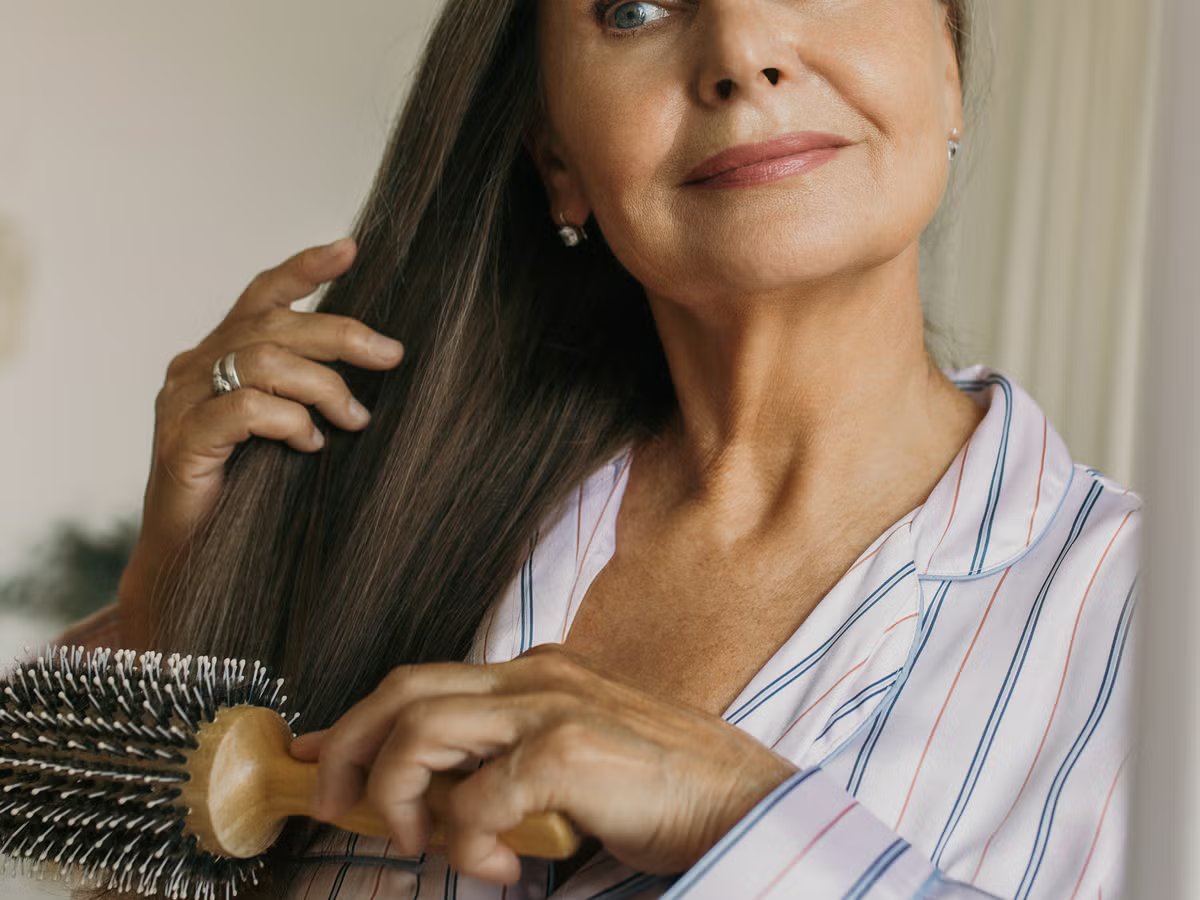
We all know the signs of aging skin—dark spots, textural changes, fine lines, and wrinkles—but we may not be as familiar with the signals of aging hair. Although it is constantly regenerating, hair can change with time due to genetics, lifestyle, and hormonal shifts. “Hair tends to become thinner, grows more slowly, loses pigment, and often feels drier or more brittle as we age due to changes in the hair follicle and scalp environment,” explains Mona Gohara, M.D., board-certified dermatologist and associate clinical professor at the Yale School of Medicine. “Think of hair like a delicate fabric—the more wear and tear it endures, the faster it frays.”
The biggest culprits: lifestyle and genetics. “Stress, diet, medications, environmental exposures, and styling habits all influence how hair ages,” says Shab Caspara, board-certified trichologist and founder of Caspara Studio. While we can control our daily routine, the same can’t be said for genes. “If your parents or grandparents experienced thinning or early graying, you can likely expect similar changes to your own hair,” says Temur Hamilton, hair colorist and stylist, and owner of TEMUR in Manhattan. “That said, the right lifestyle habits and hair care routine can keep your hair looking younger and healthier for much longer.”
Signs of aging hair
It’s not your imagination—your hair might look and feel different. Experts explain the five most common hair changes over the years.
✔️ Sign #1: Loss of pigment. Going gray is one of the most obvious signs of aging hair. “Gray hair occurs when pigment-producing cells (melanocytes) in follicles slow down or stop,” Dr. Gohara says. “On average, graying hair for Caucasians can begin in their mid-30s, Asians in their late 30s, and those of African descent in their mid-40s.”
✔️ Sign #2: Dullness and dryness. Wondering where that natural glossiness went? “As the scalp produces less sebum with age, especially after menopause, the natural shine and slip caused by sebum and oils coating the strands diminish,” says Good Housekeeping Beauty Lab Director Sabina Wizemann. “This can result in drier-looking hair and increased coarseness, making hair brittle and more prone to damage, as well as duller in appearance. Additionally, as the hair shaft ages and melanin decreases, hair can become more porous and develop a rougher cuticle layer, which does not scatter light as effectively as the smooth surfaces of healthy, aligned cuticles.”
✔️ Sign #3: Thinning. “Hair thinning often begins when women are in their 40s or 50s, but it can start earlier due to hormonal shifts, especially around menopause,” Dr. Gohara says. As we age, the hair follicle starts to shrink, which results in thinner hair. Certain health conditions and medications can speed up thinning.
✔️ Sign #4: Slower growth. Hair grows more slowly due to weakened cellular activity in the follicles and shorter growth cycles. The anagen (growth) phase of hair shortens as we age, so fewer strands are actively growing at any time. “Reduced blood circulation to the scalp and hormonal decline also contribute,” Caspara says.
✔️ Sign #5: Textural changes. “Hair texture changes over time as a result of hormonal shifts, reduced oil production, and accumulated damage,” Hamilton says. “Curly hair tends to loosen, while straight hair often feels coarser with age.”
How to keep hair looking young
You can’t stop aging, but you can certainly slow it down, especially when it comes to your hair. These are the best ways to tweak hair care and styling routines to address aging hair.

Add Good Housekeeping as a preferred source in your Google search results.
Use your Google account to add this to your settings.

- Give yourself a scalp massage: Applying gentle pressure onto your scalp has major perks, particularly for hair growth that has slowed down. “Laser devices and scalp massage can counteract this by stimulating circulation,” Caspara says.
- Update your hair care routine: If hair is feeling dry and stiff, you can restore some softness with hydrating products, serums, and regular haircuts. “While you can’t entirely prevent these changes, you can help preserve your hair’s health and texture by using moisturizing masks and bond-repair treatments,” Hamilton says. We love Dove Intensive Repair 10-in-1 Serum Mask.
- Make lifestyle tweaks: “Stress, nutrition, UV exposure, smoking, and chemical or heat styling can accelerate how quickly hair changes with age,” Dr. Gohara says. A healthy, nutrient-rich diet and regular exercise can make a difference.
- Switch up your style: What worked a few years ago may not be giving you the same results. “Adjust hairstyles to flatter evolving texture and density,” Dr. Gohara says. “Everyone’s hair is different, so talk with your hairstylist to decide what works best for your hair type!”
- Limit exposure to the elements: “Keeping your hair and scalp away from environmental stressors (like sunlight) can help slow down visible changes,” Hamilton says.
- Lay off the hot tools: “For mature hair, focus on moisture, protection, and gentle styling,” Hamilton says. “Use nourishing, strengthening hair care products, and apply a moisturizing and reparative mask once per week. When it comes to styling, less is more—work with your natural texture whenever possible and try to avoid too much heat styling.” When you do style your hair with hot tools, be sure to use
a heat protectant, like GH Beauty Lab pick Kérastase Elixir Ultime Original Oil. - Pamper your scalp: Healthy hair starts at the scalp, so treat it accordingly. “Preventive steps include daily scalp cleansing using scalp-friendly and scalp-nourishing shampoos like GH pick Redken Acidic Bonding Concentrate Shampoo, as well as consistent use of supplements, scalp topicals, and devices such as low-level laser therapy,” Caspara says.
- Get that shine back: “Hydrating masks, conditioners, and leave-in products can smooth lifted and rough cuticles, making hair softer and more resilient,” Wizemann says. “They also add shine without greasiness. Glosses and toners can boost light reflection. Clarifying shampoos once a week also remove buildup and dulling residue, which can boost shine.”
How to care for gray hair
Pros answer your most burning questions to embrace the shade.
Q: How can I transition seamlessly from colored to gray hair?
A: If you’ve been coloring grays for years, it’s best to see a pro when you’re considering embracing silver. “Blending is key for smoothly transitioning from colored to gray hair,” Hamilton says. “Highlights, lowlights, and a softer, more natural base color all help ease the grow-out line. It’s important to work with a skilled stylist to transition gradually and gracefully.”
Q: What are the best care tips and products for silver strands?
A: “Gray hair is not just a loss of pigment; it also experiences structural and physical changes, including variations in moisture content and strength,” Wizemann says. “Conditioning-focused products are recommended, like GH Lab Tested Matrix Food For Soft Multi-Use Hair Oil Serum, as gray hair may feel and look drier.”
Use a clarifying or purple shampoo once a week to help neutralize unwanted yellow or brassy tones that gray hair can pick up—GH Lab Tested pick L’Oreal Paris EverPure Brightening and Nourishing Shampoo for Gray Hair, is a good one to try. When styling, use a little extra TLC as gray hair is very fragile. “Always apply a heat protectant first, use lower temperatures, and avoid tugging too much on the hair,” Hamilton says.
Celia Shatzman (she/her) is a Brooklyn-based writer and editor who has penned stories on topics ranging from beauty to fashion, travel, celebrities, health, entertainment, finance and more. A graduate of the Medill School of Journalism at Northwestern University, she is a beauty and style contributor at Forbes and her work has appeared in New York, Cosmopolitan, WWD, ELLE, Conde Nast Traveler, Afar, Travel + Leisure, Women’s Health, Marie Claire, Byrdie, Refinery29 and NYLON, among others.